Percussion Synth
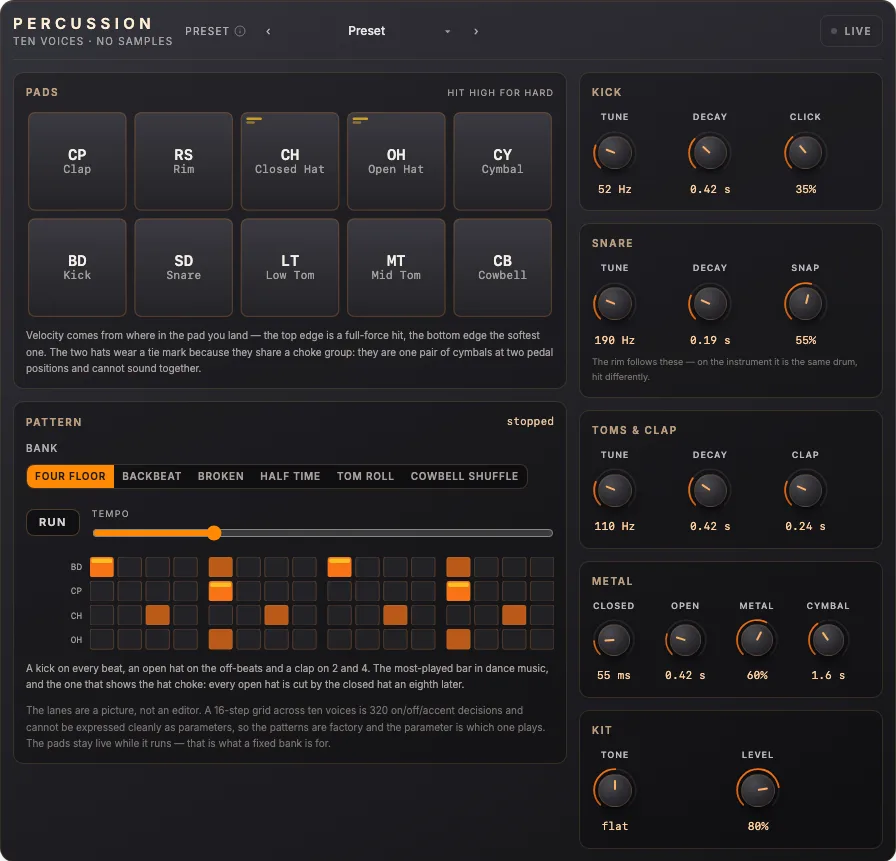
A sample-free drum synth with ten circuits and sixteen steps.
Preview
A clock-synced drum grid you can draw directly.
Engine preview
Not built for macOS, Windows or Linux
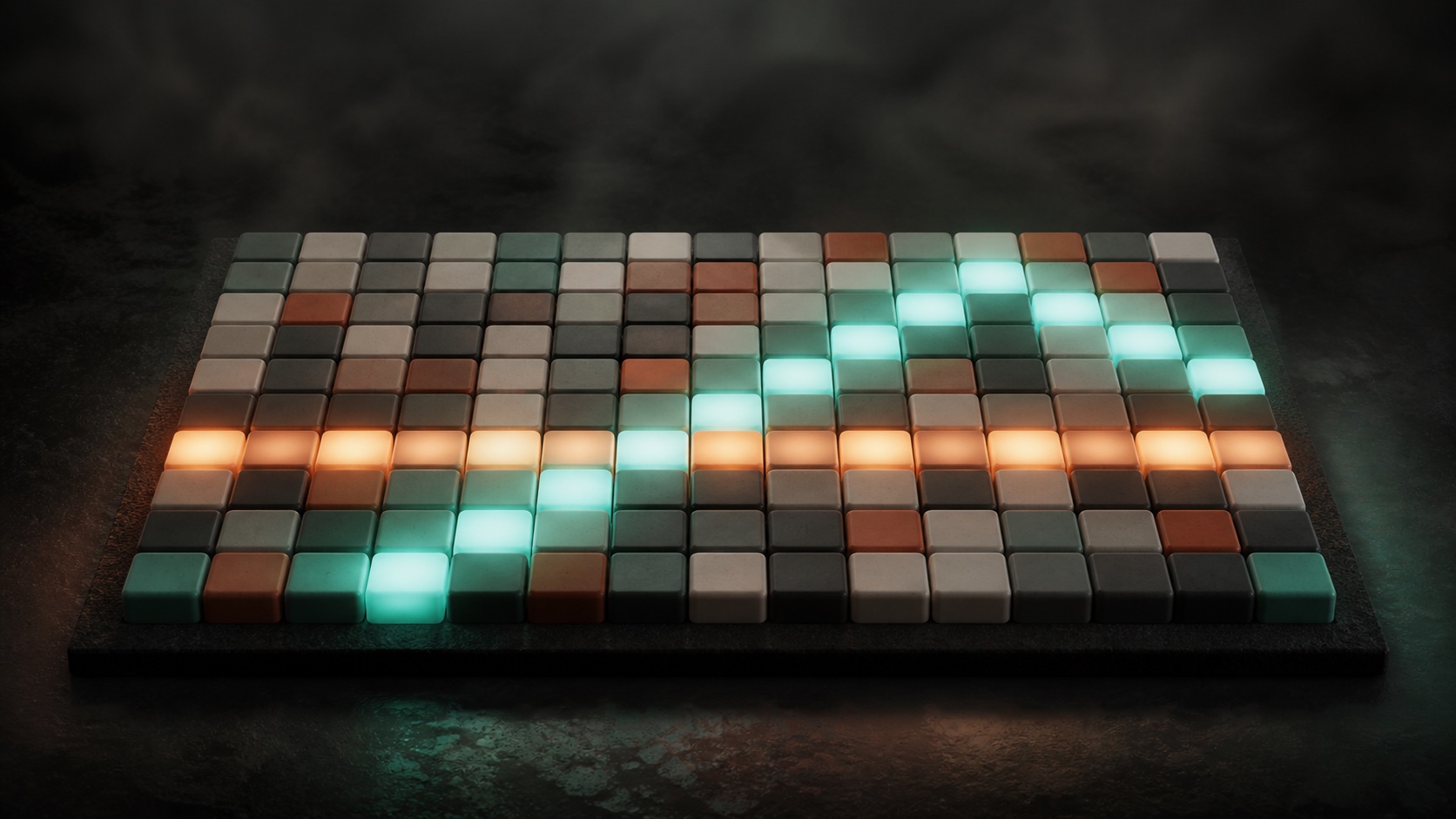
Drumstep is the direct drum-grid sequencer: one row per familiar kit voice and one square per step. The compact view keeps ten core drum roles in reach, while the 16-lane view adds ride, high tom, congas, tambourine and shaker. A dark square is silent, a colored square is a hit, and the brighter capped state is an accent.
The rows follow the General MIDI percussion map, so kick is note 36, clap is 39, snare is 38, closed hat is 42 and the rest line up with hardware pads, drum tracks and standard MIDI files. Drumstep produces those notes and leaves the sound entirely to the connected instrument.
Division is relative to the shared session clock. At 1/16, four squares pass per beat; changing to 1/8 or 1/32 changes the grid rate without introducing another tempo that can drift away from the transport.
Playback follows the shared transport position whenever the host runs. Preview auditions the pattern on a private clock without starting or stopping the parent timeline, and immediately yields when the host begins playback.
The editable grid is pattern state, not automation. Division, Swing and fixed MIDI velocity are ordinary parameters, while the retained 32-step lanes remain a compact musical object owned by the sequencer. Solo and mute immediately change both the timeline emphasis and the MIDI output.
Every row below is a recorded build row or the recorded absence of one. Nothing here is inferred from what this module is meant to support.
| Format | Result | Download |
|---|---|---|
| Browser package (JS) | Not built by this module's lane this module has no release.json; its packager lane records no browser program rows | Not built for the browser |
| Browser package (WASM) | Not built by this module's lane this module has no release.json; its packager lane records no browser program rows | Not built for the browser |
| VST3 | Not built — the native export is blocked native-export.json records nativeEligibility "blocked" | Not built for macOS, Windows or Linux |
| Audio Unit | Not built — the native export is blocked native-export.json records nativeEligibility "blocked" | Not built for macOS |
| CLAP | Not built — the native export is blocked native-export.json records nativeEligibility "blocked" | Not built for macOS, Windows or Linux |
| Standalone app | Not built — the native export is blocked native-export.json records nativeEligibility "blocked" | Not built for macOS, Windows or Linux |
Parity
No lane recorded an artifact; there is no parity evidence.
Migration fallback: approximated from parameter groups, not a runtime wiring diagram.
The face stores ten 32-cell master lanes and reveals 4, 8, 16 or 32 cells across the same measure. StepLane supplies the three-state click cycle, drag painting, keyboard operation and the fractional playhead, so every row uses the same tested gesture rules.
A shared playback helper arbitrates one clock: the host timeline always wins, while an explicitly local preview supplies PPQ only when the host is stopped. The UI converts that position through the selected division and emits the active column whenever the chosen clock crosses a step.
Each lane has a musical role and an independent output mapping. It defaults to the corresponding General MIDI note on channel 10, but its inline target can address any MIDI note and channel—for example, keeping the generator's Kick logic while triggering a sampler's non-GM kick pad.
A rack is a fixed rig: several modules already wired together, playable as one instrument. This module is one of the pieces.
Drumstep sequences a selected 16-sample Moodbox bank through one shared transport.
2 modules · drumstep → moodbox
A sample-free drum synth with ten circuits and sixteen steps.
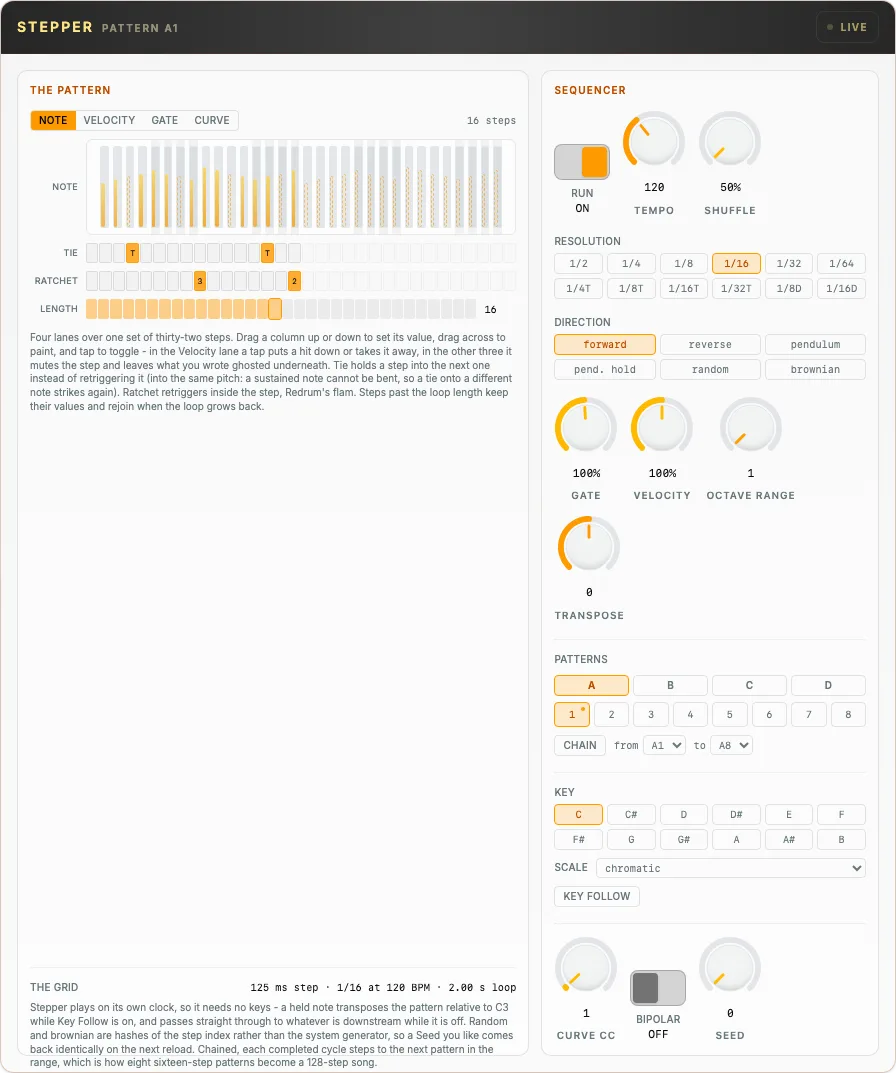
A 32-step Matrix, with ties, ratchets and a curve lane.
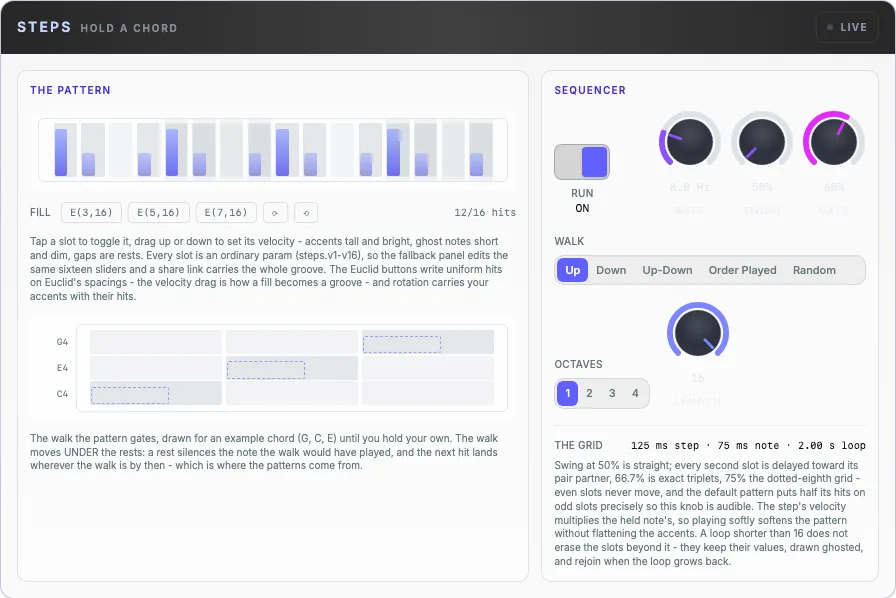
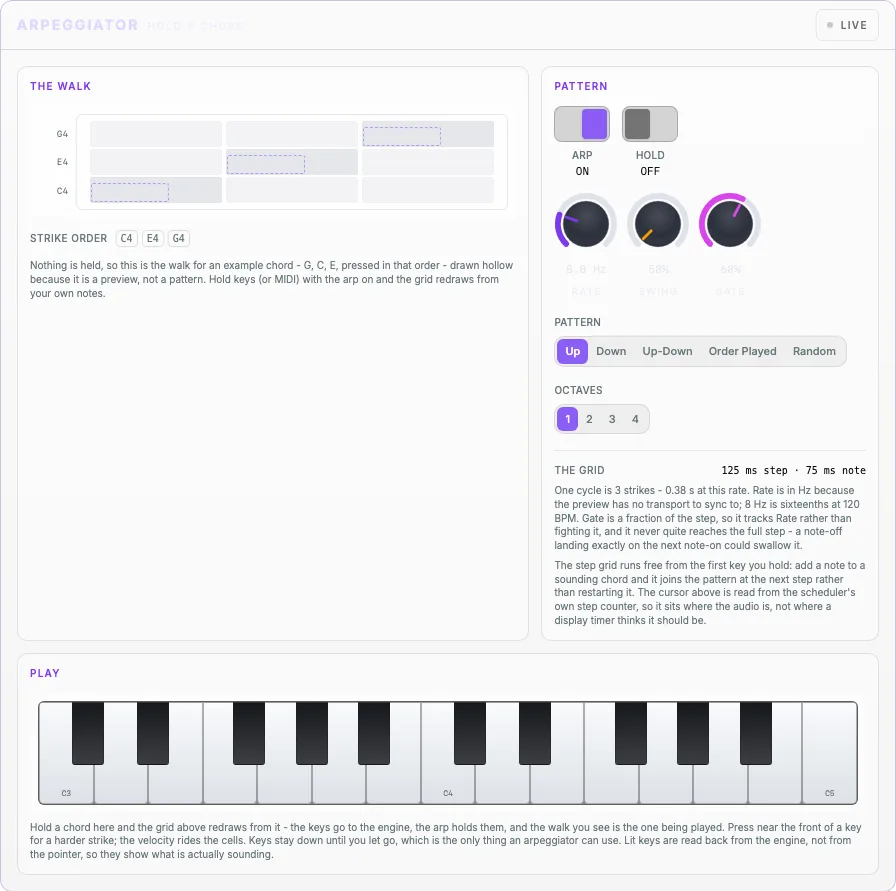
A step sequencer and arpeggiator on one grid.
Walk held notes through a rhythmic pattern.