OSC Mini
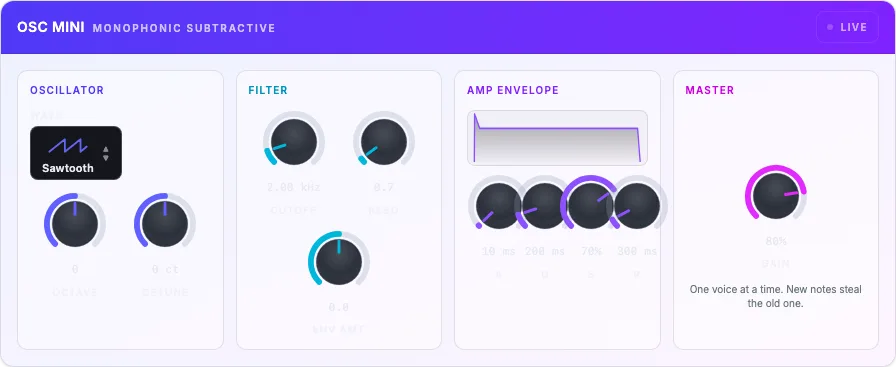
A compact subtractive synth for learning the signal path.
Preview
A TB-303-style monophonic acid synthesizer.
Engine preview
VST3
The TB-303 Bass Line was a commercial failure when Roland released it in 1981 as a practice tool for guitarists. A decade later, Phuture's 'Acid Tracks' turned its resonant squelch into the defining sound of acid house. This module keeps that performance vocabulary while moving the active engine to the repository's independently rebuilt JUCE-compatible restricted-TypeScript API.
The filter is a nonlinear four-stage low-pass ladder with a separately high-passed resonance return. The 150 Hz default keeps the feedback from overwhelming the fundamental; changing it fattens or thins the squelch without changing the public patch schema.
The oscillator continuously morphs between saw and square. PolyBLEP corrections soften the discontinuities before the oscillator and filter are evaluated at four times the device sample rate, keeping keyboard-range sweeps controlled without loading tables or performing I/O in the realtime callback.
Accent is not just a louder note. The 303's accent circuit cross-modulates both the filter cutoff and the amplitude simultaneously through dual RC envelope paths — a fast path (attack around 15 ms, modulating cutoff by 314 to 2394 Hz depending on accent depth) and a slow path that shapes the amplitude. This is what gives accented notes their characteristic 'wow': the filter opens wider AND the note gets louder, with the two trajectories slightly offset in time. The Accent knob scales both paths together.
Slide (portamento) is a leaky integrator that smoothly slews pitch from one note to the next. On the original 303, slide is per-step: when a step has slide enabled, the pitch glides from the previous note over the slide time rather than jumping. Combined with accent, slide is the source of the 303's most expressive gestures — the rising squelch of an accented slide into a high note.
The downloadable Acid Bass release supports the hosts and systems listed below.
Works in Ableton Live, Reaper, Cubase, Studio One, Bitwig and FL Studio.
Every row below is a recorded build row or the recorded absence of one. Nothing here is inferred from what this module is meant to support.
| Format | Result | Download |
|---|---|---|
| Browser package (JS) | Builtweb bundle sha256 5977308060c7… · 303 KB | Built, but no downloadable archive was recorded. |
| Browser package (WASM) | Builtweb bundle sha256 d60e3d78159b… · 2.0 MB | Built, but no downloadable archive was recorded. |
| VST3 | Builtdarwin-arm64Steinberg validator + VST3 host render: passed bundle sha256 37a72dbc739d… · 2.1 MB | CodexAcidBass-vst3-darwin-arm64.zip archive sha256 edd50a539378… · 2.1 MB · darwin-arm64 |
| Audio Unit | Not built no recorded artifact row for au; native-lane-report.json is absent or records no au row for this module | Not built for macOS |
| CLAP | Not built no recorded artifact row for clap; native-lane-report.json is absent or records no clap row for this module | Not built for macOS, Windows or Linux |
| Standalone app | Not built no recorded artifact row for standalone; native-lane-report.json is absent or records no standalone row for this module | Not built for macOS, Windows or Linux |
Parity
browser-js = browser-wasm = vst3 qualified against their own recorded digests. Not recorded: au, clap, standalone.
Start from a named sound, then adjust the instrument to make it yours.
Migration fallback: approximated from parameter groups, not a runtime wiring diagram.
A compact subtractive synth for learning the signal path.
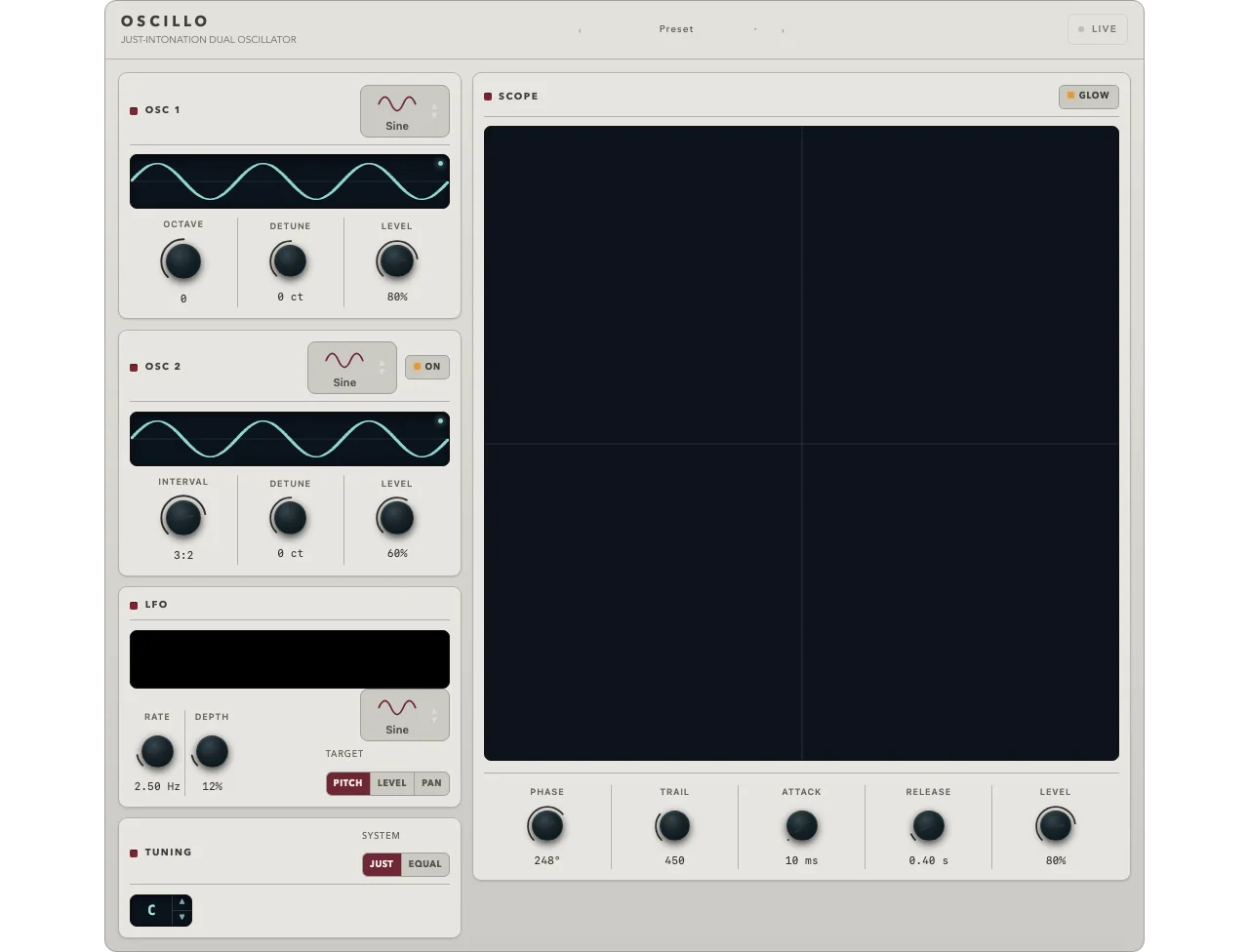
A synth controlled through a visual tuning display.
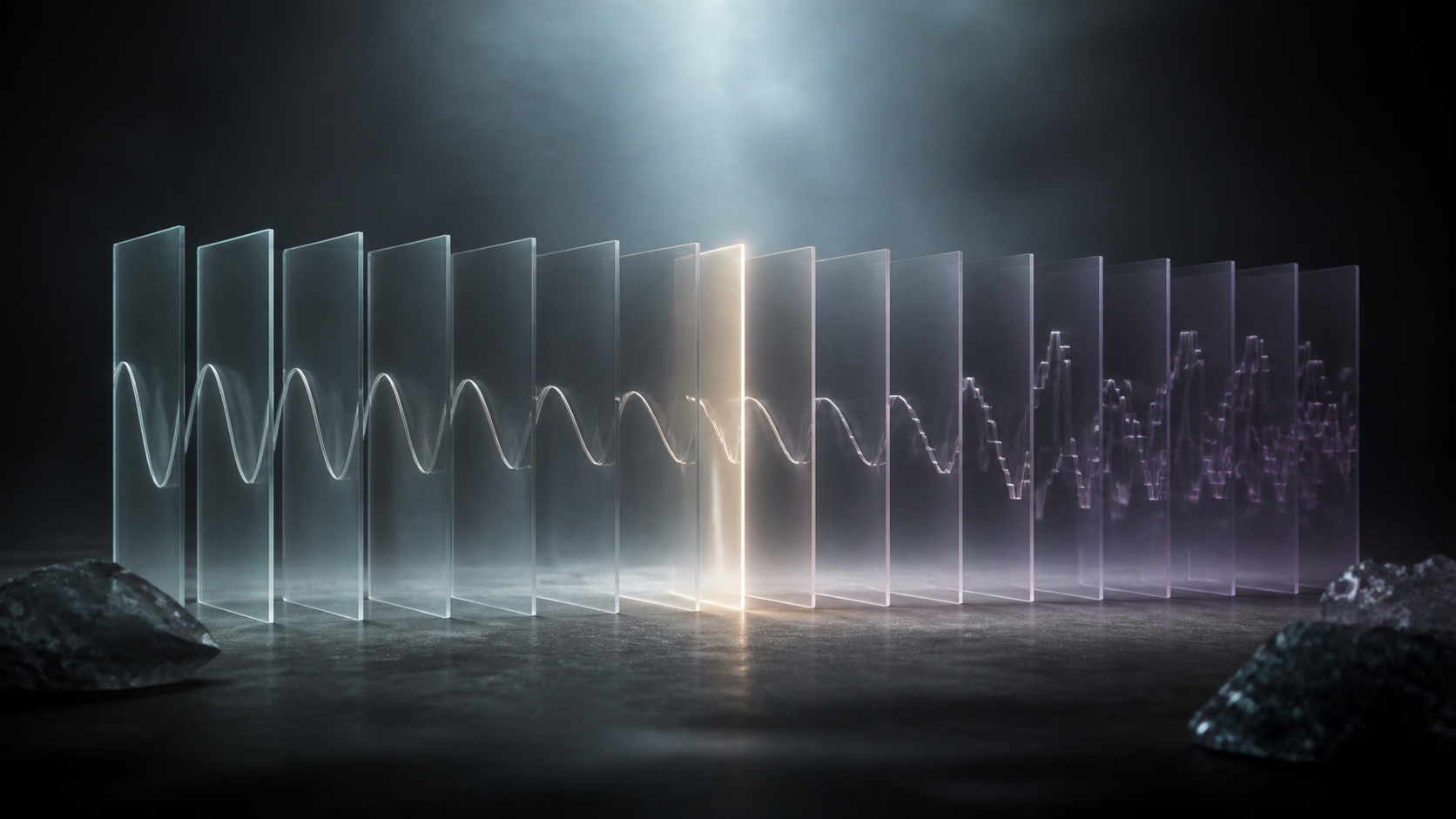
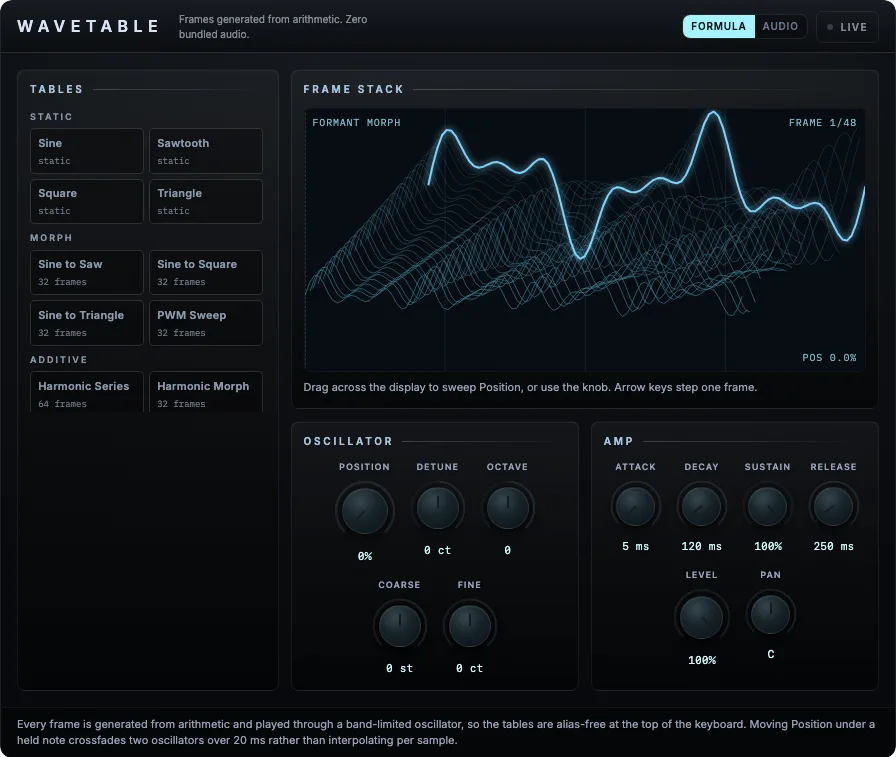
Single-cycle waves with continuous position morphing.
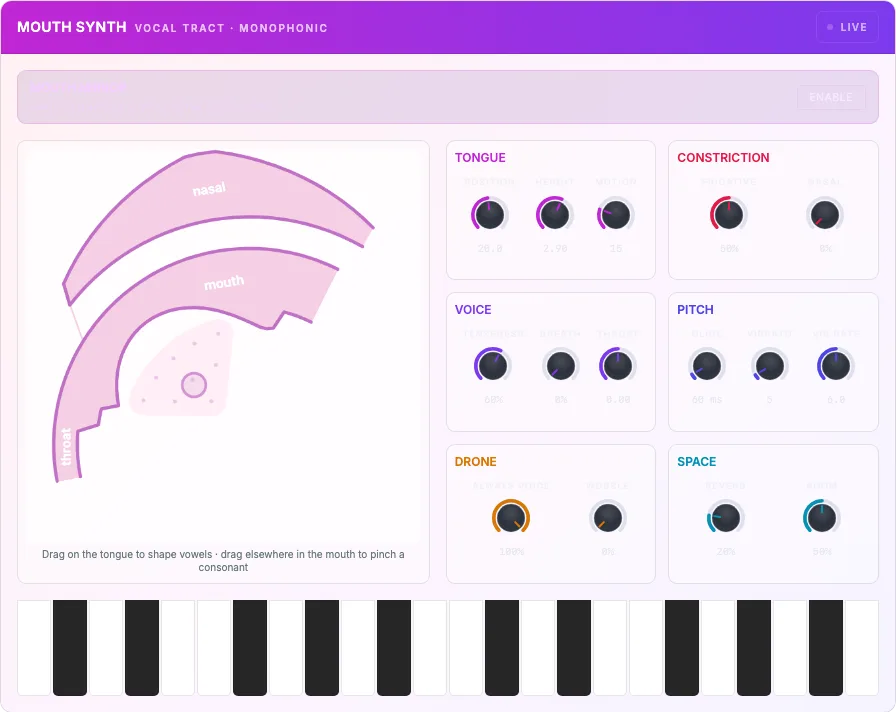
A vocal tract you play like a synth.