
CamMod
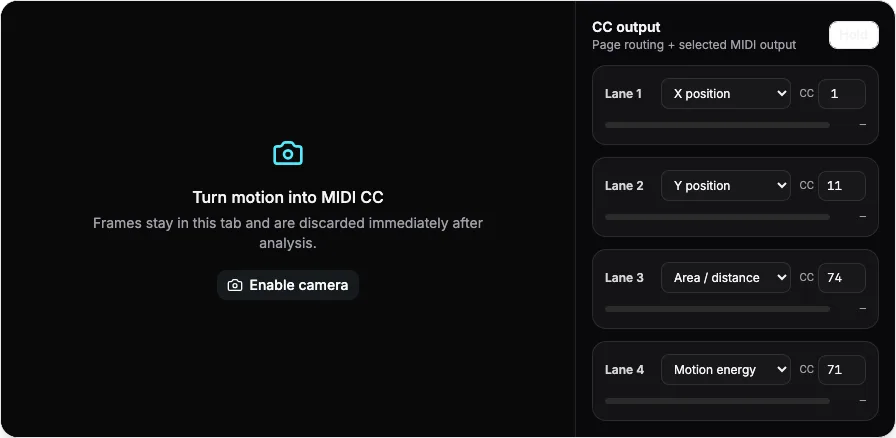
Map camera motion to MIDI CC.
PreviewNot built for macOS, Windows or Linux
A compact subtractive synth for learning the signal path.
Engine preview
VST3
OSC Mini is the classic signal path - oscillator into a resonant filter into an amplitude envelope - with nothing bolted on. No unison stack, no macro page, no eight-slot modulation matrix to get lost in. That's the point: it's small enough that you can learn the whole instrument in an afternoon and then actually know something, which is more than most of us can say about the synths we own.
It's also the teaching example. OSC Mini's DSP, parameter schema, presets and interface are the same files the quickstart walks you through, which means the tutorial isn't a toy version of a real plugin - it is this plugin. If you clone it and change the filter to a state-variable design, you have made your own synth, and it will build as a VST3 the same afternoon.
Musically it lands where a single sawtooth and a good filter always land: basses that sit under things, plucks with the envelope pulled short, and long dumb pads that are better than they have any right to be. Push the resonance past about 12 and it will start to sing on its own, which is either a feature or a warning depending on your monitoring.
The downloadable OSC Mini release supports the hosts and systems listed below.
Works in Ableton Live, Reaper, Cubase, Studio One, Bitwig and FL Studio.
Every row below is a recorded build row or the recorded absence of one. Nothing here is inferred from what this module is meant to support.
| Format | Result | Download |
|---|---|---|
| Browser package (JS) | Builtweb bundle sha256 b3aec733f2a5… · 361 KB | Built, but no downloadable archive was recorded. |
| Browser package (WASM) | Builtweb bundle sha256 e86e4aed48a3… · 2.0 MB | Built, but no downloadable archive was recorded. |
| VST3 | Builtdarwin-arm64Steinberg validator + VST3 host render: passed bundle sha256 3da430eda143… · 2.1 MB | CodexOscMini-vst3-darwin-arm64.zip archive sha256 14e745ed8d97… · 2.1 MB · darwin-arm64 |
| Audio Unit | Not built no recorded artifact row for au; native-lane-report.json is absent or records no au row for this module | Not built for macOS |
| CLAP | Not built no recorded artifact row for clap; native-lane-report.json is absent or records no clap row for this module | Not built for macOS, Windows or Linux |
| Standalone app | Not built no recorded artifact row for standalone; native-lane-report.json is absent or records no standalone row for this module | Not built for macOS, Windows or Linux |
Parity
browser-js = browser-wasm = vst3 qualified against their own recorded digests. Not recorded: au, clap, standalone.
Migration fallback: a page-only authored drawing, not yet runtime or export truth. Dashed cables carry modulation, not audio.
The path is oscillator into a biquad low-pass into an ADSR into a gain stage, in that order, one voice at a time. The oscillator produces a band-limited waveform at the note frequency, offset by Octave and Detune. That signal runs through a second-order biquad low-pass, whose corner frequency is set by Cutoff and pushed around by Env Amt. The amplitude envelope then shapes level over the life of the note, and Master Gain scales what leaves.
The envelope is doing double duty: the same ADSR that controls loudness also modulates the filter cutoff by Env Amt. That's a deliberate simplification - real synths give the filter its own envelope, and if you want that, the clone-and-edit path below is about twenty lines of work. Sharing one envelope is why OSC Mini has eleven parameters instead of eighteen, and why the whole thing fits on one screen.
Two honest limitations. It is monophonic - new notes steal the voice, so legato playing retriggers rather than layers. And the filter is a single biquad, so it rolls off at 12 dB per octave and self-oscillates in the whistling-resonance way rather than the warm-analog way. Neither is a bug we plan to hide; both are on the list for OSC-1.
A rack is a fixed rig: several modules already wired together, playable as one instrument. This module is one of the pieces.
Linestep writes a melodic pattern and OSC Mini plays it as one subtractive voice.
2 modules · linestep → osc-mini