Drumstep
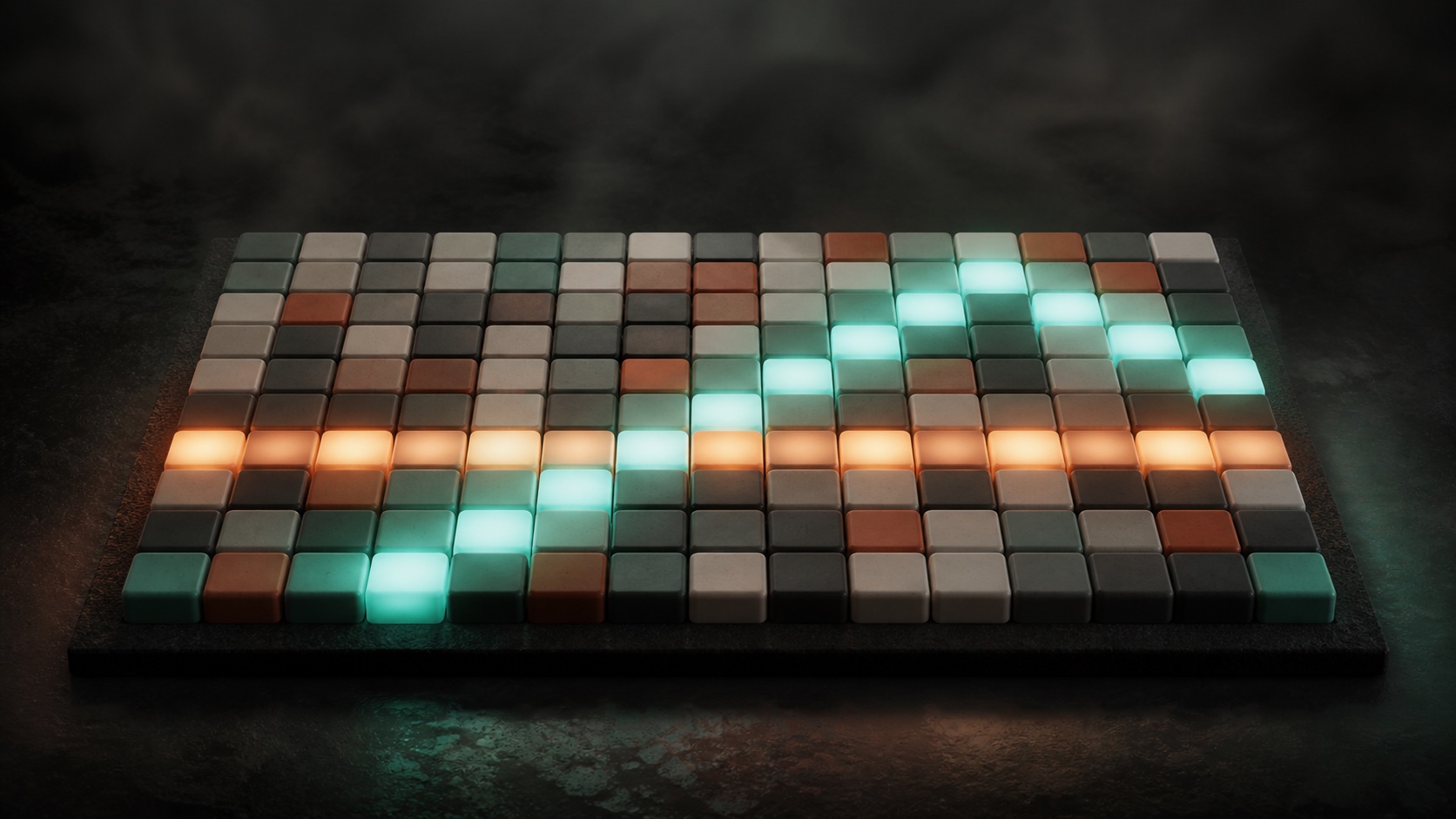
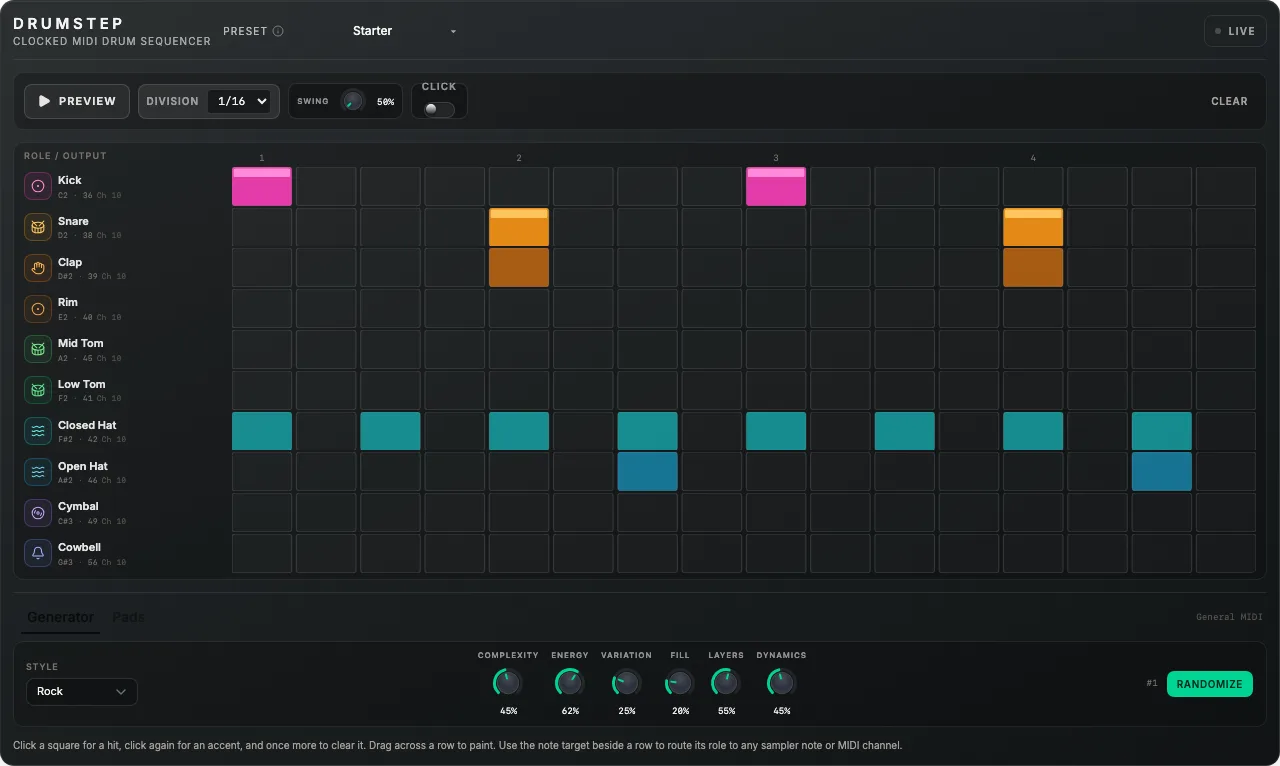
A clock-synced drum grid you can draw directly.
PreviewNot built for macOS, Windows or Linux
Draw a melodic line on a clocked pitch grid.
Engine preview
Not built for macOS, Windows or Linux
Linestep places pitch vertically and time horizontally on a fixed one-measure step grid. Notes are MIDI events only, so the connected instrument remains responsible for sound.
The fast generator writes directly into the same editable pattern using a selected style, key, scale, density, motion, octave range, variation and repeatable seed. It is deliberately model-independent, so a later MIDI-GPT source can target the same pattern shape without replacing the grid or scheduler.
Arm MIDI record while either the host transport or local preview is running and incoming keyboard or hardware notes are quantized into the crossed step. The piano gutter and row flash show the note being received without writing that transient state into the pattern.
Monophonic mode does not rewrite the pattern. If a column contains several notes, the most recently drawn note sounds while the others remain visible in gray. Switching to Polyphonic makes the retained notes sound again.
Division changes how much timing detail the editor reveals. The pattern keeps a 32-step master timeline, so choosing a coarser view hides fine notes without deleting them.
Transpose edits the drawn material by semitone or octave. Output reassignment is separate: mapping the C4 reference to another note offsets MIDI output without changing anything drawn in the grid.
Every row below is a recorded build row or the recorded absence of one. Nothing here is inferred from what this module is meant to support.
| Format | Result | Download |
|---|---|---|
| Browser package (JS) | Not built by this module's lane this module has no release.json; its packager lane records no browser program rows | Not built for the browser |
| Browser package (WASM) | Not built by this module's lane this module has no release.json; its packager lane records no browser program rows | Not built for the browser |
| VST3 | Not built — the native export is blocked native-export.json records nativeEligibility "blocked" | Not built for macOS, Windows or Linux |
| Audio Unit | Not built — the native export is blocked native-export.json records nativeEligibility "blocked" | Not built for macOS |
| CLAP | Not built — the native export is blocked native-export.json records nativeEligibility "blocked" | Not built for macOS, Windows or Linux |
| Standalone app | Not built — the native export is blocked native-export.json records nativeEligibility "blocked" | Not built for macOS, Windows or Linux |
Parity
No lane recorded an artifact; there is no parity evidence.
Migration fallback: approximated from parameter groups, not a runtime wiring diagram.
The UI-kit StepGrid owns hit testing, drag painting, keyboard operation and playhead geometry. Linestep maps its rows to MIDI pitches and its columns through the shared retained-resolution timeline.
The same grid now owns the reusable piano-key gutter, raw MIDI-number option and live-lane feedback. Linestep supplies pitch rows and incoming note state; the primitive keeps those display rules available to the next melodic sequencer.
Pattern truth is a list of drawn notes per retained master step. Playback policy is derived from that truth, so Monophonic can gray non-emitting notes without removing them and Polyphonic can restore them immediately.
The shared playback helper gives the host transport priority over local Preview. Every crossed column emits through the module MIDI sink with the selected gate, swing, velocity policy, reference-note offset and channel.
A rack is a fixed rig: several modules already wired together, playable as one instrument. This module is one of the pieces.
Linestep writes a melodic pattern and OSC Mini plays it as one subtractive voice.
2 modules · linestep → osc-mini
A clock-synced drum grid you can draw directly.
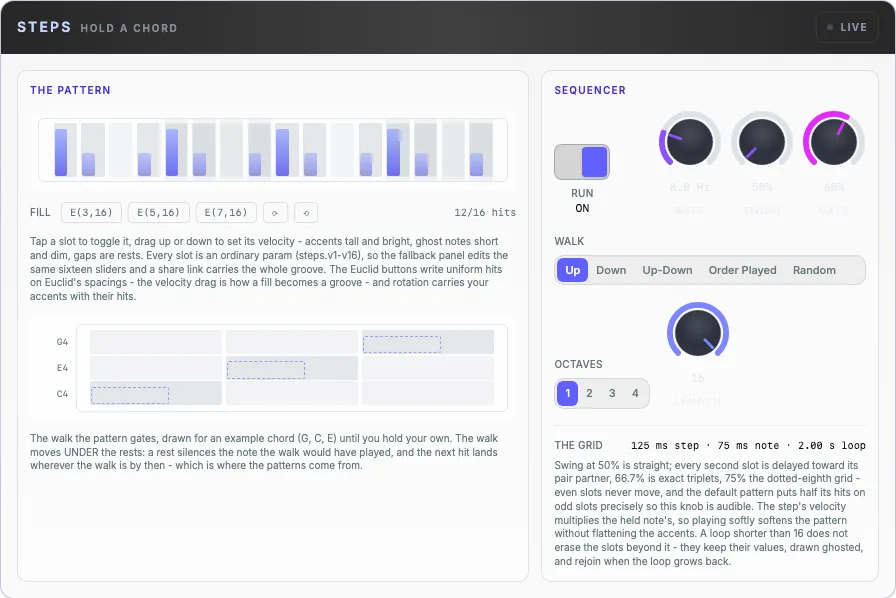
A step sequencer and arpeggiator on one grid.
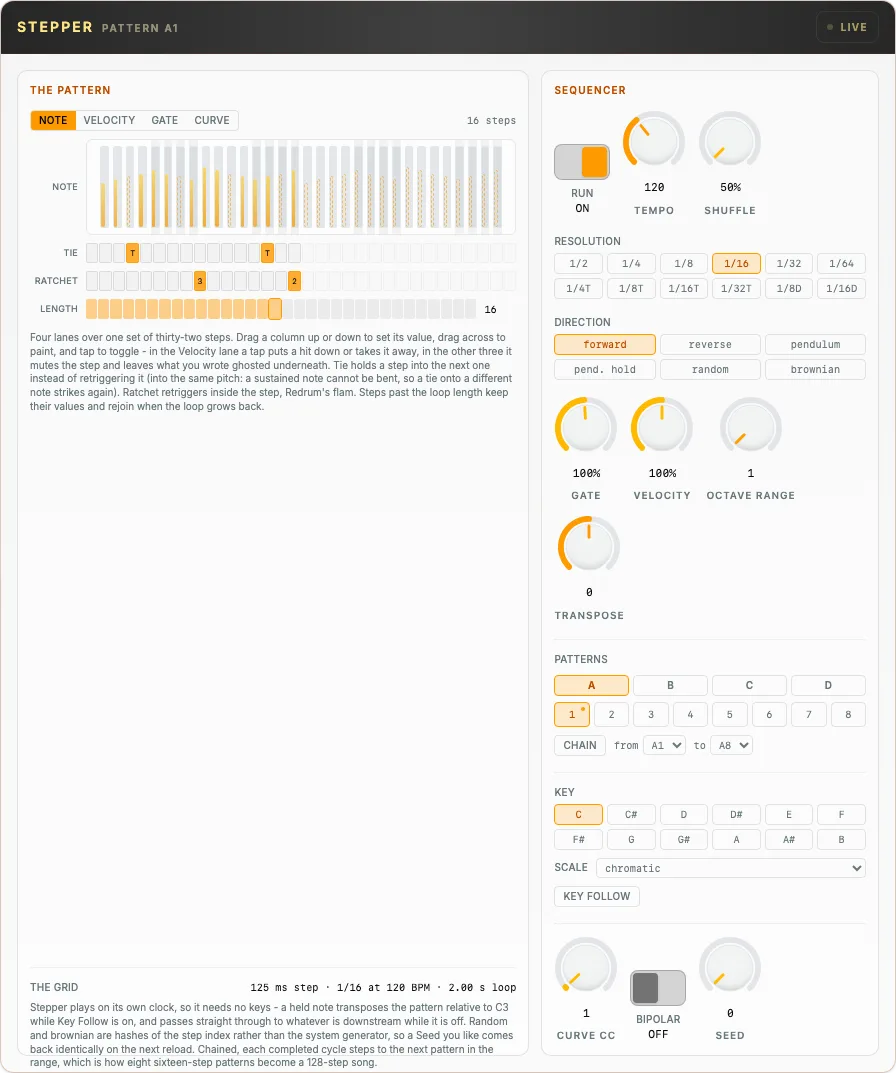
A 32-step Matrix, with ties, ratchets and a curve lane.
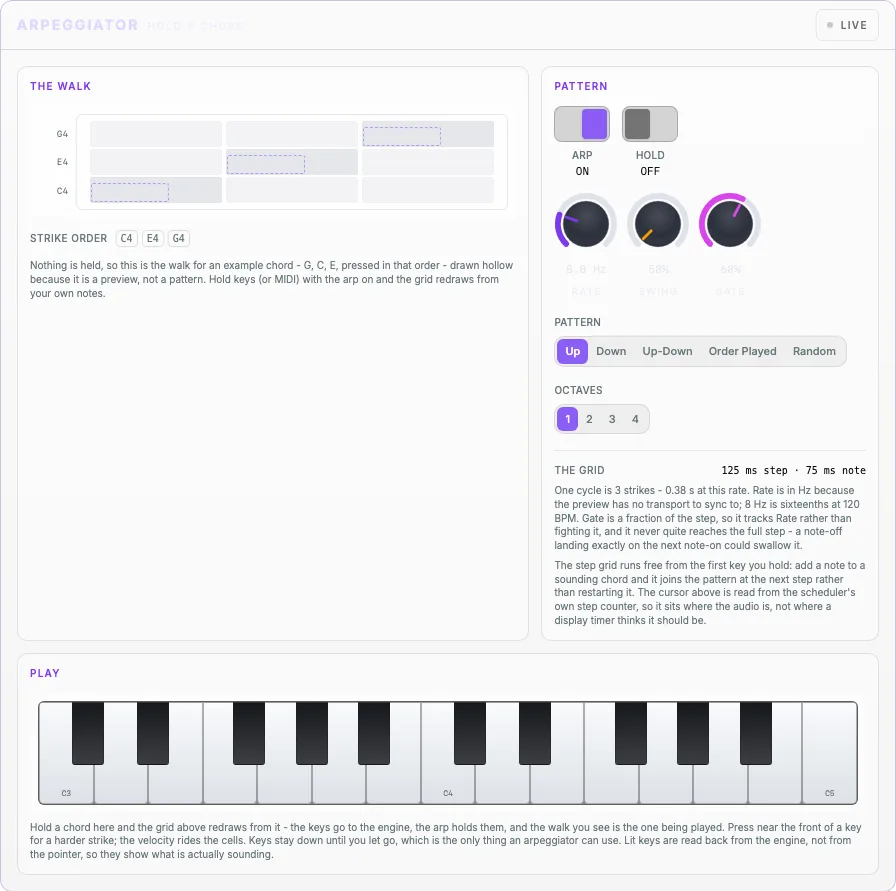
Walk held notes through a rhythmic pattern.