Space Mini
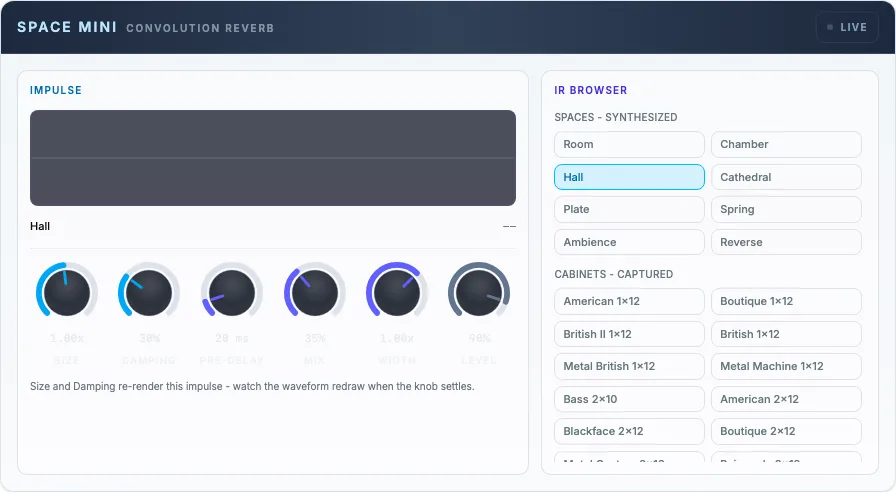
Convolution reverb: eight synthesized spaces, twenty-five real cabinets.
PreviewNo build recorded
Phaser and vibrato with independent LFOs.
Engine preview
Browser version
Two modulation effects in series: a ten-stage allpass phaser and a delay-line vibrato, each with its own rate, depth and mix.
Migration fallback: approximated from parameter groups, not a runtime wiring diagram.
The phaser is a cascade of ten allpass filters. An allpass passes every frequency at full level and only shifts phase, which is why the cascade on its own is inaudible - the effect appears when that shifted copy is summed against the dry one and the two cancel wherever they are out of phase. That is what Phaser Mix controls, and it is why the sweep is deepest at 0.5 where the two paths are equal.
One LFO sweeps all ten stages together, between the base frequency and the base frequency raised by Octaves. Moving the notches is what you hear as movement. Q decides how those notches are distributed rather than how deep they are: measured on the browser preview, a low Q scatters them from about 130 Hz to 6 kHz while Q=20 packs them into roughly 1.3-1.9 kHz around the sweep, with comparable depth in both cases. Wide and airy against tight and vocal is the choice that knob actually makes.
The vibrato is a delay line whose length is modulated by a second, independent LFO. Changing a delay line's length while audio is running through it resamples what is passing through, so the pitch genuinely rises and falls - this is pitch modulation, not amplitude. The line spans 5 ms and rests at its midpoint, and Depth scales the swing about that centre.
This is the browser preview: Web Audio allpass biquads and a DelayNode, structured after the reference phaser and vibrato modules rather than compiled from the same kernel. Only these two of the modulation family are implemented - there is no chorus, tremolo, auto-pan or auto-wah section here, and no tempo sync. Both sections are mono, so the stereo spread a hardware phaser would offer is absent rather than approximated.
Convolution reverb: eight synthesized spaces, twenty-five real cabinets.
Drive, tone, and bounded feedback delay.