Amp Rig
Tube-style drive into a real cabinet.
PreviewNo build recorded
Drive, tone, and bounded feedback delay.
Engine preview
VST3
Distortion into a tone filter into a feedback delay - the pedalboard starter chain, and the SDK's teaching effect. The same kernel drives the offline batch renderer.
The downloadable FX Mini release supports the hosts and systems listed below.
Works in Ableton Live, Reaper, Cubase, Studio One, Bitwig and FL Studio.
Every row below is a recorded build row or the recorded absence of one. Nothing here is inferred from what this module is meant to support.
| Format | Result | Download |
|---|---|---|
| Browser package (JS) | Builtweb bundle sha256 db6b22f97a26… · 462 KB | Built, but no downloadable archive was recorded. |
| Browser package (WASM) | Builtweb bundle sha256 e68df90611b5… · 2.0 MB | Built, but no downloadable archive was recorded. |
| VST3 | Builtdarwin-arm64Steinberg validator + VST3 host render: passed bundle sha256 8259c0bcf192… · 2.1 MB | CodexFxMini-vst3-darwin-arm64.zip archive sha256 46cc4178fb05… · 2.1 MB · darwin-arm64 |
| Audio Unit | Not built no recorded artifact row for au; native-lane-report.json is absent or records no au row for this module | Not built for macOS |
| CLAP | Not built no recorded artifact row for clap; native-lane-report.json is absent or records no clap row for this module | Not built for macOS, Windows or Linux |
| Standalone app | Not built no recorded artifact row for standalone; native-lane-report.json is absent or records no standalone row for this module | Not built for macOS, Windows or Linux |
Parity
browser-js = browser-wasm = vst3 qualified against their own recorded digests. Not recorded: au, clap, standalone.
Migration fallback: approximated from parameter groups, not a runtime wiring diagram.
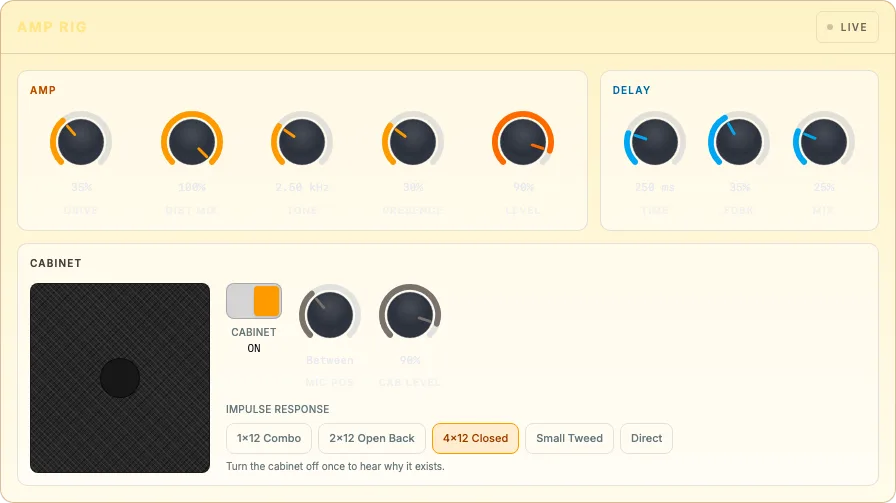
The chain is distortion into a tone filter into a feedback delay, in that order and with nothing hidden between the stages. The drive stage is a waveshaper with its own wet/dry mix, so you can blend saturated signal under the clean one rather than committing to it.
Tone is a biquad low-pass sweeping 200 Hz to 8 kHz, placed after the distortion because that is where a tone control does the most work - filtering harmonics the drive stage just generated, rather than filtering the input before they exist.
The delay is single-tap with feedback capped at 0.9. That cap is deliberate: the delay will self-oscillate and sing at the top of its range, but it cannot run away and damage your monitoring. This is the same kernel the offline batch renderer uses, so a render matches what you hear here.