Delay
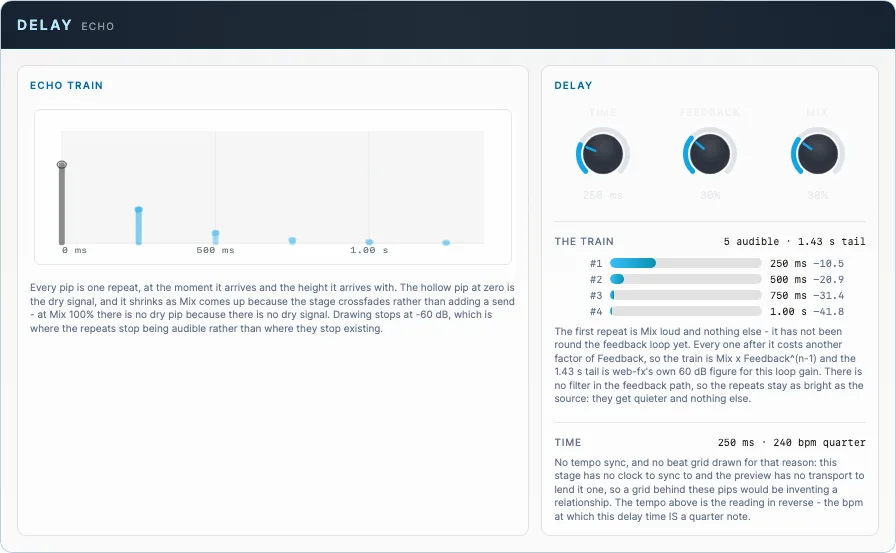
A bounded feedback delay for repeats and ambience.
PreviewNot built for macOS, Windows or Linux
Cross-coupled delay with alternating repeats.
Engine preview
Not built for macOS, Windows or Linux
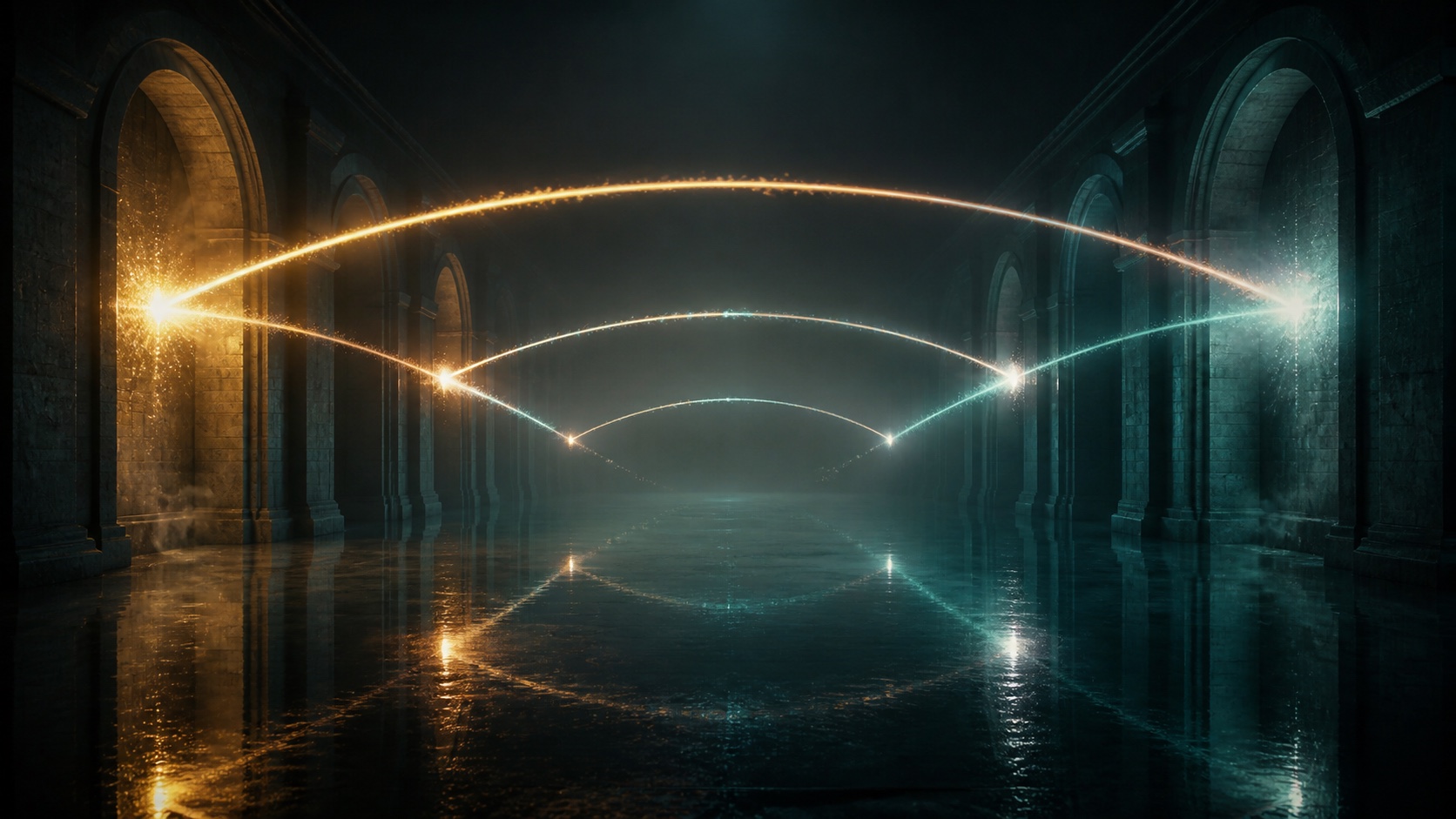
Two delay lines wired into each other's inputs, so a single hit leaves on the left, comes back on the right, and keeps alternating. The bounce is the routing rather than anything scheduled, which is why it stays correct at any delay time.
Every row below is a recorded build row or the recorded absence of one. Nothing here is inferred from what this module is meant to support.
| Format | Result | Download |
|---|---|---|
| Browser package (JS) | Not built by this module's lane this module has no release.json; its packager lane records no browser program rows | Not built for the browser |
| Browser package (WASM) | Not built by this module's lane this module has no release.json; its packager lane records no browser program rows | Not built for the browser |
| VST3 | Not built no recorded artifact row for vst3; native-lane-report.json is absent or records no vst3 row for this module | Not built for macOS, Windows or Linux |
| Audio Unit | Not built no recorded artifact row for au; native-lane-report.json is absent or records no au row for this module | Not built for macOS |
| CLAP | Not built no recorded artifact row for clap; native-lane-report.json is absent or records no clap row for this module | Not built for macOS, Windows or Linux |
| Standalone app | Not built no recorded artifact row for standalone; native-lane-report.json is absent or records no standalone row for this module | Not built for macOS, Windows or Linux |
Parity
No lane recorded an artifact; there is no parity evidence.
Start from a named sound, then adjust the instrument to make it yours.
Two delay lines are cross-coupled: the left one's output feeds both the left output channel and the right line's input, and the right one's does the mirror image. A single impulse therefore emerges on the left after one delay time, on the right after two, on the left after three, and so on. Nothing counts repeats or schedules sides, the alternation is a property of the loop, which is why it stays correct at any delay time and needs no re-scheduling when the time knob moves.
The input is summed to mono before it enters the loop, and that is deliberate rather than a limitation. If a stereo source kept its channels, both lines would be seeded at once and the first repeat would arrive on both sides simultaneously, which is precisely the bounce not happening. The dry path keeps the source's own image; only the repeats are mono-seeded.
Feedback is applied at each crossing, so it multiplies twice per full cycle back to the starting side. That is the practical difference from a plain delay's feedback knob: the same number gives a shorter tail here, and the cap the two effects share is measured against the per-crossing gain, which makes it conservative for the round trip rather than marginal.
This is the browser preview: two DelayNodes, two gains and a channel merger, structured after the reference ping-pong delay rather than compiled from the same kernel, and making no parity claim against it. There is no tempo sync and no filtering in the feedback path, so the repeats stay as bright as the source instead of darkening the way an analogue-voiced delay would.
A bounded feedback delay for repeats and ambience.
Drive, tone, and bounded feedback delay.
Convolution reverb: eight synthesized spaces, twenty-five real cabinets.