Auto Panner
Move a signal across the stereo field.
PreviewNot built for macOS, Windows or Linux
Adjust stereo width without changing the dry signal.
Engine preview
Not built for macOS, Windows or Linux
A mid/side matrix that scales the difference between the channels. Turns a stereo image out toward the speakers or collapses it to mono, and does nothing at all to a mono source.
Every row below is a recorded build row or the recorded absence of one. Nothing here is inferred from what this module is meant to support.
| Format | Result | Download |
|---|---|---|
| Browser package (JS) | Not built by this module's lane this module has no release.json; its packager lane records no browser program rows | Not built for the browser |
| Browser package (WASM) | Not built by this module's lane this module has no release.json; its packager lane records no browser program rows | Not built for the browser |
| VST3 | Not built no recorded artifact row for vst3; native-lane-report.json is absent or records no vst3 row for this module | Not built for macOS, Windows or Linux |
| Audio Unit | Not built no recorded artifact row for au; native-lane-report.json is absent or records no au row for this module | Not built for macOS |
| CLAP | Not built no recorded artifact row for clap; native-lane-report.json is absent or records no clap row for this module | Not built for macOS, Windows or Linux |
| Standalone app | Not built no recorded artifact row for standalone; native-lane-report.json is absent or records no standalone row for this module | Not built for macOS, Windows or Linux |
Parity
No lane recorded an artifact; there is no parity evidence.
Start from a named sound, then adjust the instrument to make it yours.
The exact normalized graph packaged for the shared browser/native runtime and exports.
The signal is split into mid and side, the sum of the two channels and their difference, the side is scaled by Width, and the two are recombined. Everything a stereo widener does follows from that: the mid is what both speakers agree on, the side is what they disagree on, and widening is simply turning the disagreement up.
This is also why the effect has a hard limit that no setting escapes. A mono source has no side signal at all, so there is nothing to scale and no width setting produces any change, feed it something genuinely stereo, either a stereo clip through the input panel or the chain's two oscillators panned apart, or this module will sit there doing nothing and be right to.
The browser preview does not build an explicit encode-scale-decode chain, because width control is already linear in L and R and collapses into a single 2x2 gain matrix. Substituting mid and side back into the output equations gives each channel a `same` coefficient on itself and a `cross` coefficient on the other, which is four GainNodes between a splitter and a merger and no summing stages beyond the merge itself.
Those coefficients are where the param range comes from. Width maps onto the side scaler as twice its value, which puts 0.5 at unity, the signal passes through exactly as recorded, 0 at full mono, and 1 at double side, where the image pushes out past the speakers and anything panned centre starts to feel hollow.
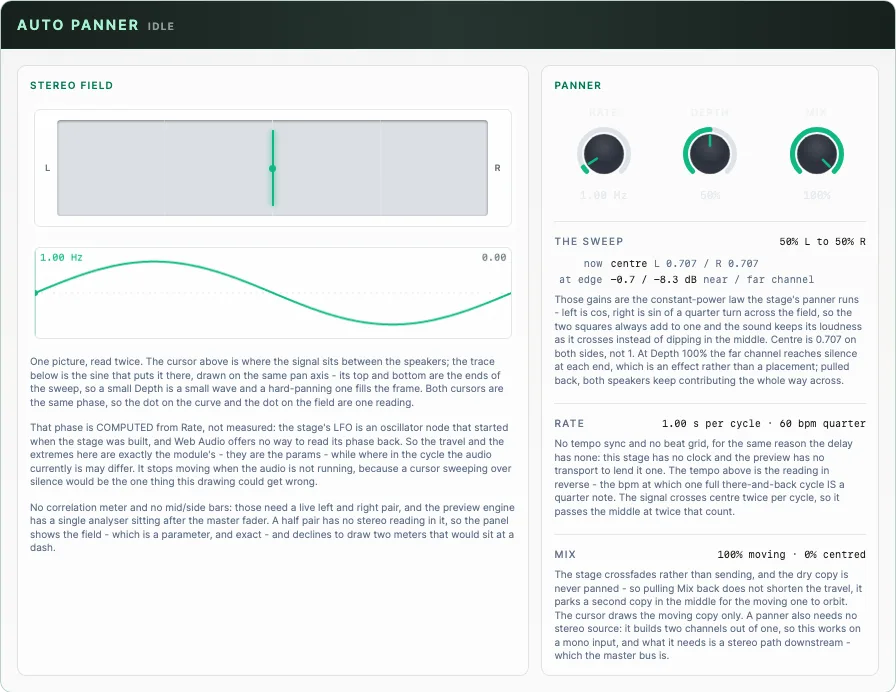
Move a signal across the stereo field.
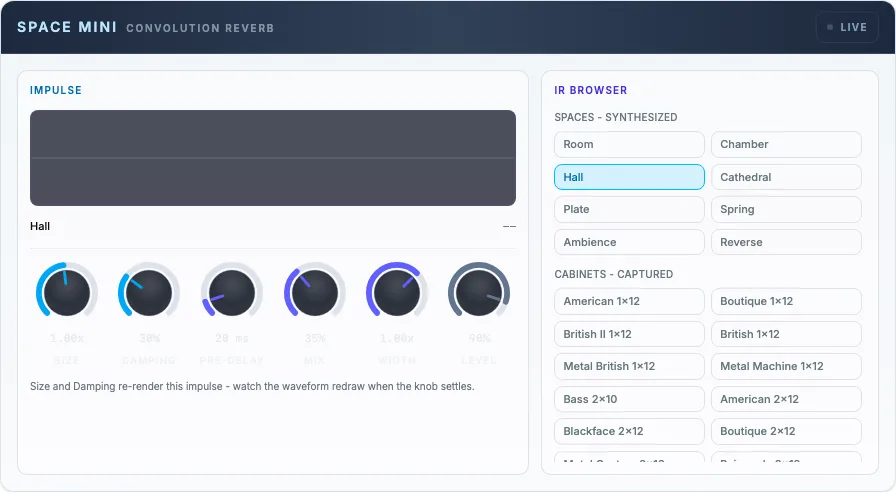
Convolution reverb: eight synthesized spaces, twenty-five real cabinets.
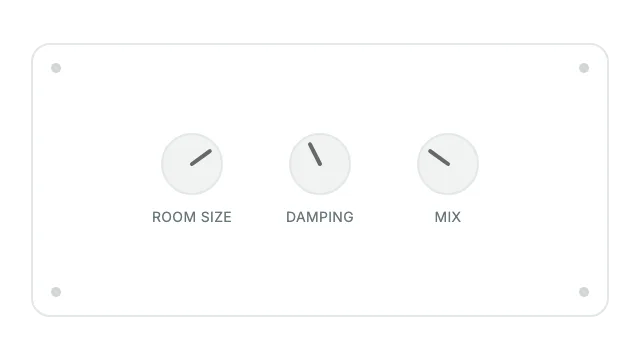
Algorithmic room reverb with bounded feedback.