
Tremolo
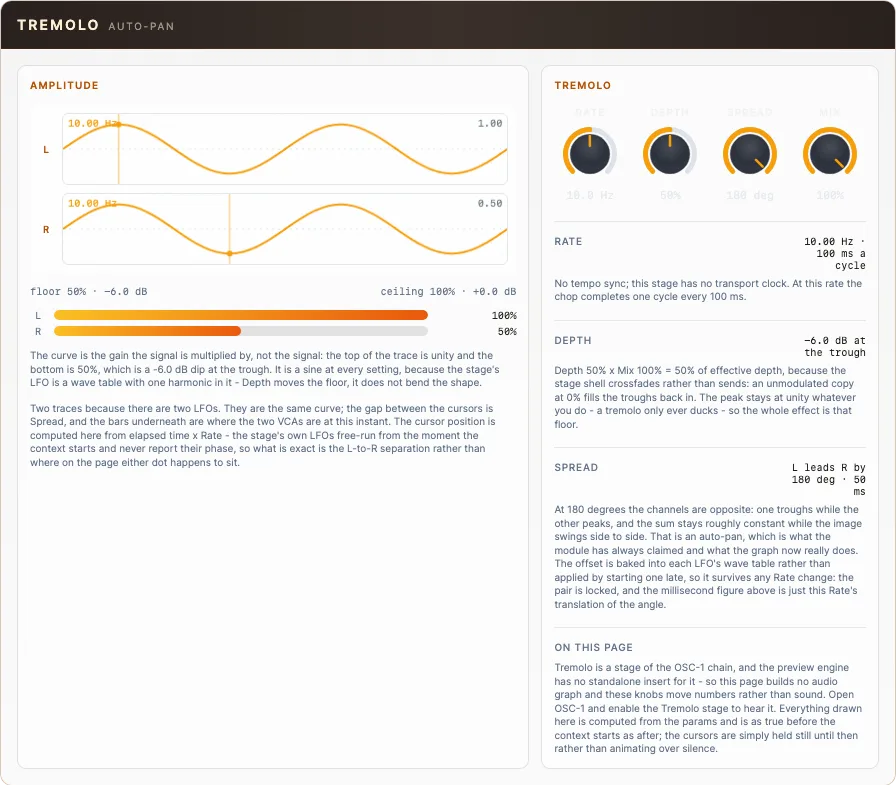
Periodic amplitude modulation with stereo phase control.
PreviewNot built for macOS, Windows or Linux
Move a signal across the stereo field.
Engine preview
Not built for macOS, Windows or Linux
An LFO walks the signal across the stereo field. Rate, depth, and the oldest trick for making one sound occupy two speakers.
Every row below is a recorded build row or the recorded absence of one. Nothing here is inferred from what this module is meant to support.
| Format | Result | Download |
|---|---|---|
| Browser package (JS) | Not built by this module's lane this module has no release.json; its packager lane records no browser program rows | Not built for the browser |
| Browser package (WASM) | Not built by this module's lane this module has no release.json; its packager lane records no browser program rows | Not built for the browser |
| VST3 | Not built no recorded artifact row for vst3; native-lane-report.json is absent or records no vst3 row for this module | Not built for macOS, Windows or Linux |
| Audio Unit | Not built no recorded artifact row for au; native-lane-report.json is absent or records no au row for this module | Not built for macOS |
| CLAP | Not built no recorded artifact row for clap; native-lane-report.json is absent or records no clap row for this module | Not built for macOS, Windows or Linux |
| Standalone app | Not built no recorded artifact row for standalone; native-lane-report.json is absent or records no standalone row for this module | Not built for macOS, Windows or Linux |
Parity
No lane recorded an artifact; there is no parity evidence.
Start from a named sound, then adjust the instrument to make it yours.
The exact normalized graph packaged for the shared browser/native runtime and exports.
A sine LFO at Rate drives a stereo panner's position between full left and full right, with Depth scaling how far from centre it goes. That is the entire effect, it is amplitude modulation applied in opposite directions to two channels, which is also why a tremolo with its channels 180 degrees out of phase turns into one.
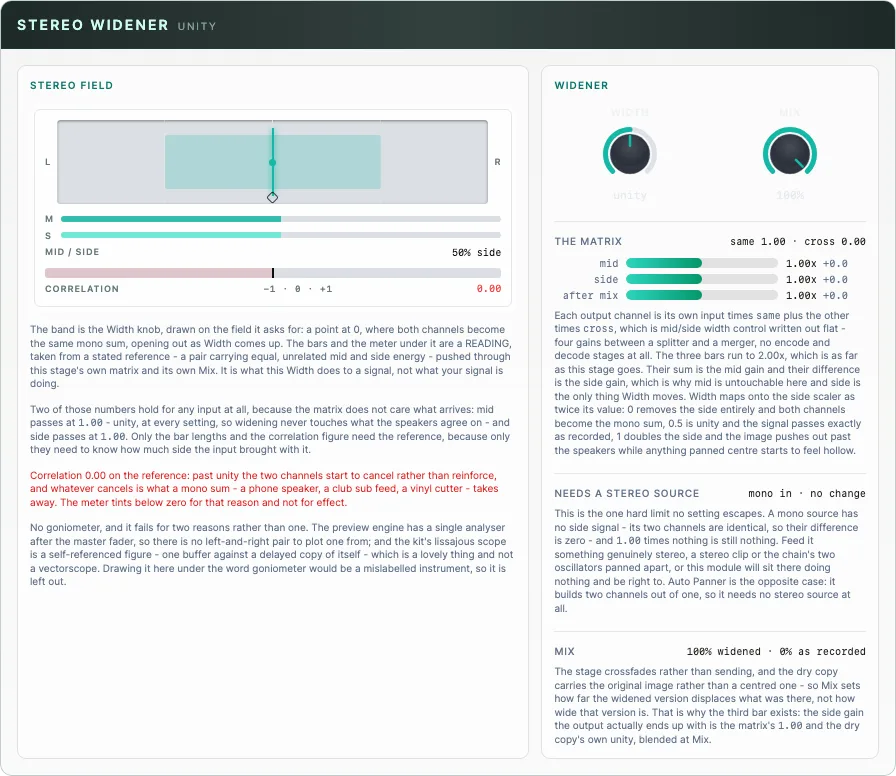
The browser preview runs it on a StereoPannerNode with the LFO summed into its pan parameter, all at audio rate. A panner constructs the two channels rather than requiring them, so this works on a mono source, which is the difference between this module and Stereo Widener, whose matrix has nothing to scale unless the input already carries a side signal.
Depth at 1 reaches hard left and hard right, and at the panner's equal-power law that means each channel is briefly silent while the other is full. Pulling Depth back keeps both speakers contributing throughout, which is usually what a mix wants; the extremes are more useful as an effect than as a placement.
Periodic amplitude modulation with stereo phase control.
Adjust stereo width without changing the dry signal.
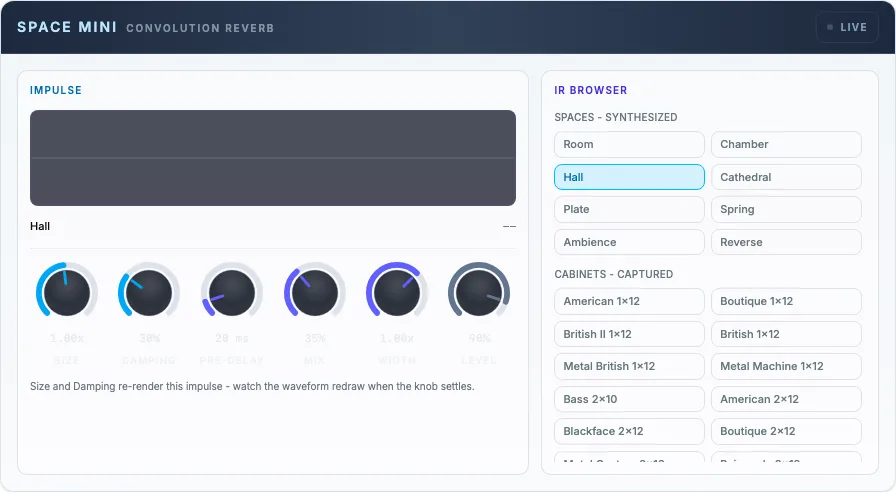
Convolution reverb: eight synthesized spaces, twenty-five real cabinets.