FX Mini
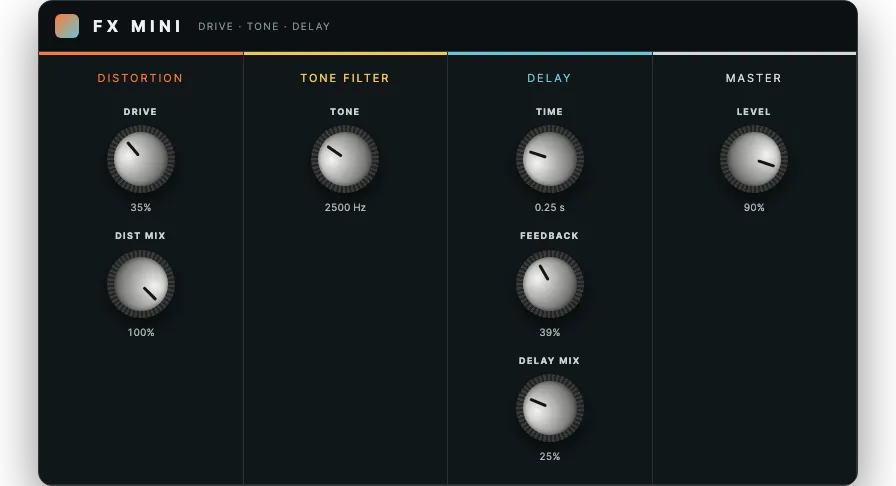
Drive, tone, and bounded feedback delay.
Preview
Tube-style drive into a real cabinet.
Engine preview
Browser version
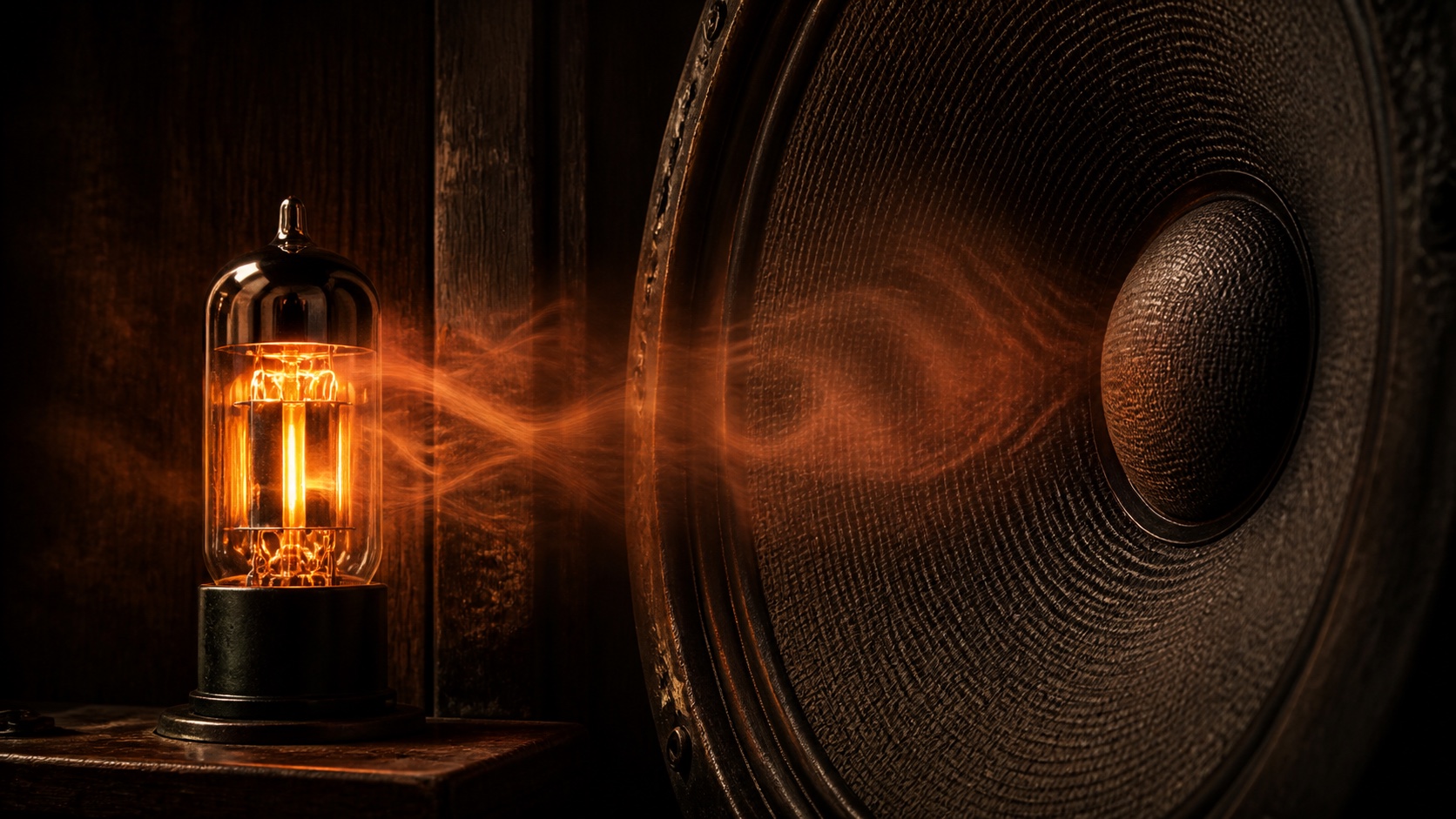
Most of what makes an amp sound like an amp isn't the distortion - it's the speaker. A guitar cabinet is a small, resonant, badly-behaved loudspeaker in a wooden box, and it throws away everything above about 5 kHz that makes plain distortion sound like a wasp in a jar. Amp Rig takes the FX Mini chain you can already play - drive, tone, delay - and puts a real cabinet impulse response at the end of it. The difference between Cabinet on and Cabinet off is the whole demo; there's a bypass switch on the cabinet block for exactly that reason.
The drive stage is a waveshaper, not a circuit model. We're not going to tell you it's a component-level simulation of a specific 1968 amplifier, because it isn't. It's a well-behaved saturation curve with a tone control in a sensible place and a cabinet convolution that does the rest, and in a mix it holds up better than that description suggests. If you want a tweed-versus-plexi argument, this is not that plugin.
The demo you're hearing is an amateur electric guitar recording, dry and unpolished on purpose - a clean DI-ish take shows what the chain is actually doing far better than a professionally produced clip would. It's public domain, and you can drop your own file in with the Your file chip, which decodes locally and never uploads anything.
Start from a named sound, then adjust the instrument to make it yours.
Migration fallback: approximated from parameter groups, not a runtime wiring diagram.
Signal order is drive into tone into presence into the cabinet IR into delay into level. The drive stage is a static waveshaper: a fixed nonlinear curve, oversampled so the harmonics it generates fold back in as little as possible rather than aliasing into ugly inharmonic junk. Tone is the same biquad low-pass FX Mini uses, sitting after the distortion where an amp's tone stack sits. Presence is a high shelf just before the speaker.
The cabinet is a partitioned convolution against a recorded impulse response - literally the measured response of a real speaker in a real box with a real microphone in front of it. Convolving your signal with that recording imposes the cabinet's frequency response and time smear onto whatever you play. It's the least clever stage in the chain and by far the most important to the sound. Mic Position crossfades between two captured positions rather than modelling mic movement, so extreme settings are interpolations, not measurements.
The delay sits after the cabinet on purpose, so repeats don't get re-filtered on every pass and turn to mud - which is what happens on real rigs with the pedal in front, and is occasionally what you want. It's a single-tap feedback delay with the feedback capped below unity.
Latency: convolution is partitioned, so the plugin reports its exact block latency to the host and your DAW compensates. The number will be published with the first build rather than guessed at here.