Squeeze
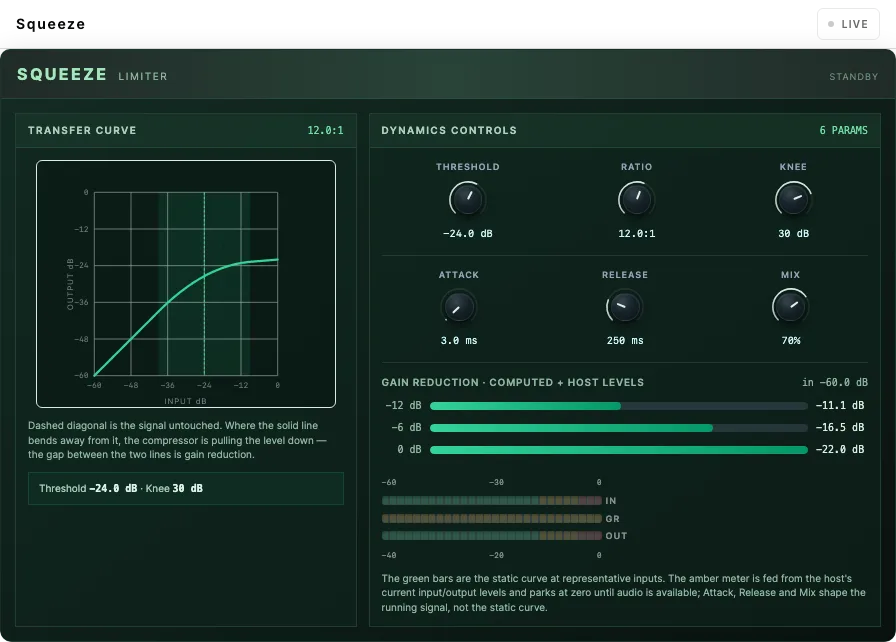
A compressor with visible gain reduction.
PreviewNot built for macOS, Windows or Linux
A noise gate with a clear threshold.
Engine preview
Not built for macOS, Windows or Linux
A noise gate: an envelope follower watching the signal level, and a gain that stays shut until the level clears the threshold. The effect that removes what you were not playing.
Every row below is a recorded build row or the recorded absence of one. Nothing here is inferred from what this module is meant to support.
| Format | Result | Download |
|---|---|---|
| Browser package (JS) | Not built by this module's lane this module has no release.json; its packager lane records no browser program rows | Not built for the browser |
| Browser package (WASM) | Not built by this module's lane this module has no release.json; its packager lane records no browser program rows | Not built for the browser |
| VST3 | Not built no recorded artifact row for vst3; native-lane-report.json is absent or records no vst3 row for this module | Not built for macOS, Windows or Linux |
| Audio Unit | Not built no recorded artifact row for au; native-lane-report.json is absent or records no au row for this module | Not built for macOS |
| CLAP | Not built no recorded artifact row for clap; native-lane-report.json is absent or records no clap row for this module | Not built for macOS, Windows or Linux |
| Standalone app | Not built no recorded artifact row for standalone; native-lane-report.json is absent or records no standalone row for this module | Not built for macOS, Windows or Linux |
Parity
No lane recorded an artifact; there is no parity evidence.
Start from a named sound, then adjust the instrument to make it yours.
The exact normalized graph packaged for the shared browser/native runtime and exports.
An envelope follower measures the signal's amplitude, and that measurement is compared against the threshold. Above it the gate is open and audio passes; below it the gate closes and the output is silence. It is not a filter and it removes nothing from inside a note, it only decides, moment to moment, whether there is a note at all.
Smoothing is the follower's time constant, and it is the one control that decides whether this sounds like a gate or like a fault. Because the same constant governs opening and closing, a setting fast enough to catch a transient is also fast enough to chatter when the signal sits near the threshold, and a setting slow enough to be smooth will let the tail of a note through the gap after it.
The browser preview builds this from four plain nodes and no worklet. A waveshaper rectifies the input, a one-pole lowpass whose cutoff is 1/(2·pi·Smoothing) averages it into an envelope, a second waveshaper maps that envelope through a soft-knee curve, 0 well below the threshold, 1 well above, a smooth ramp across the boundary, and the result is summed into a gain node's parameter. The VCA's own gain sits at zero, so the follower is the only thing that ever opens it.
The knee is what makes this usable rather than a switch, and it is deliberately not a separate control. A hard comparator chatters whenever the signal hovers at the threshold, so the curve ramps across a small band either side of it and the follower's own smoothing does the rest. Everything is audio-rate, which is the part a polling meter cannot do: the gate reacts within a sample of the transient rather than at the next animation frame.