Motion
Phaser and vibrato with independent LFOs.
PreviewNo build recorded
An all-pass phase effect with moving notches.
Engine preview
Browser version
A cascade of ten allpass filters summed against the dry signal, with an LFO walking the cancellation notches up and down the spectrum. The same imported primitive Motion runs as its phaser section, on its own page with its own knobs.
Migration fallback: approximated from parameter groups, not a runtime wiring diagram.
An allpass filter passes every frequency at full level and changes only phase, so ten of them in series are, on their own, inaudible, the output measures the same as the input. The effect exists entirely in the sum: where the cascade's accumulated phase reaches 180 degrees, the shifted copy and the dry copy cancel, and a notch appears. Everything a phaser does is that cancellation being moved around.
One LFO sweeps all ten stages together, between the base frequency and the base frequency raised by Octaves. Moving the notches is what is heard as movement, and the sweep is built from a DC offset plus the LFO summed onto each filter's frequency param rather than from scheduled values, so the travel is continuous at any rate.
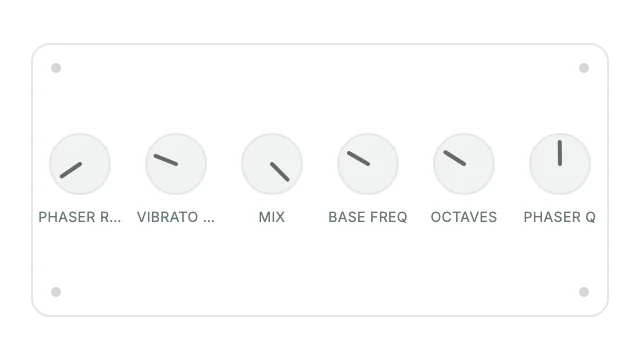
Q decides how those notches are distributed rather than how deep they are. A low setting spreads them across a wide span for a broad swirl; a high one packs them into a narrow cluster around the sweep, which is the tighter vocal-sounding phaser. Notch depth stays comparable either way, which is why this knob changes character rather than intensity.
This is the browser preview: Web Audio allpass biquads driven by an oscillator, structured after the reference phaser rather than compiled from the same kernel, and making no parity claim against it. The cascade is mono, so the stereo spread a hardware phaser offers is absent rather than approximated. The number of stages is fixed at ten, it is a construction argument on the underlying effect, so exposing it as a knob would expose a knob that does nothing.
Phaser and vibrato with independent LFOs.
Pitch modulation from a modulated delay line.
A low-pass filter driven by an LFO.