Motion
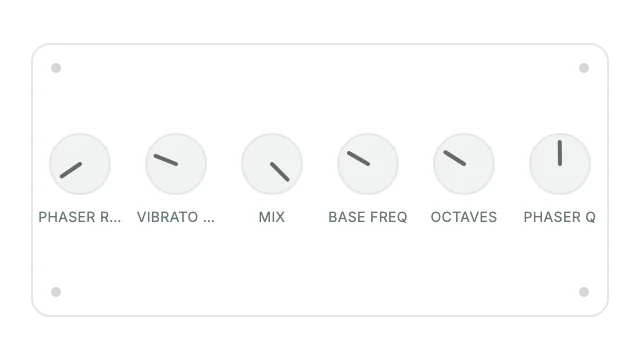
Phaser and vibrato with independent LFOs.
PreviewNo build recorded
Pitch modulation from a modulated delay line.
Engine preview
VST3
A delay line whose length is modulated by an LFO, which resamples what passes through and genuinely moves the pitch. The same imported primitive Motion runs as its vibrato section, here on its own with nothing in front of it.
The downloadable Vibrato release supports the hosts and systems listed below.
Works in Ableton Live, Reaper, Cubase, Studio One, Bitwig and FL Studio.
Every row below is a recorded build row or the recorded absence of one. Nothing here is inferred from what this module is meant to support.
| Format | Result | Download |
|---|---|---|
| Browser package (JS) | Builtweb bundle sha256 f77f623d40bd… · 291 KB | Built, but no downloadable archive was recorded. |
| Browser package (WASM) | Builtweb bundle sha256 2b28b24d953d… · 2.0 MB | Built, but no downloadable archive was recorded. |
| VST3 | Builtdarwin-arm64Steinberg validator + VST3 host render: passed bundle sha256 ac9b106fe930… · 2.1 MB | CodexVibrato-vst3-darwin-arm64.zip archive sha256 03d23c8d6de4… · 2.1 MB · darwin-arm64 |
| Audio Unit | Not built no recorded artifact row for au; native-lane-report.json is absent or records no au row for this module | Not built for macOS |
| CLAP | Not built no recorded artifact row for clap; native-lane-report.json is absent or records no clap row for this module | Not built for macOS, Windows or Linux |
| Standalone app | Not built no recorded artifact row for standalone; native-lane-report.json is absent or records no standalone row for this module | Not built for macOS, Windows or Linux |
Parity
browser-js = browser-wasm = vst3 qualified against their own recorded digests. Not recorded: au, clap, standalone.
Start from a named sound, then adjust the instrument to make it yours.
Migration fallback: approximated from parameter groups, not a runtime wiring diagram.
A delay line whose length changes while audio is running through it is a resampler. While the line is lengthening the output plays back slower and the pitch falls; while it shortens the output plays faster and the pitch rises. That is the whole mechanism, and it is why this is genuine pitch modulation rather than an amplitude effect wearing the name.
The line spans 5 ms and rests at its midpoint, with the LFO swinging symmetrically about that centre. Resting at the middle rather than at zero is what lets full depth use the entire range without the delay time ever going negative, and 5 ms is short enough that the delay itself is never heard as an echo.
Depth scales the LFO's excursion in seconds, so the pitch deviation it produces is the product of depth and rate, the rate of change of the delay length is what sets the interval, not the length. Doubling the rate at a fixed depth widens the wobble as much as doubling the depth does, which is worth knowing before reaching for the depth knob twice.
This is the browser preview: a DelayNode and an oscillator, structured after the reference vibrato rather than compiled from the same kernel, and making no parity claim against it. Nothing dry is summed inside the effect, unlike a phaser it is audible on its own, so the module's Mix is the only blend in the path. The line is mono, so there is no stereo spread here to speak of.
Phaser and vibrato with independent LFOs.
An all-pass phase effect with moving notches.
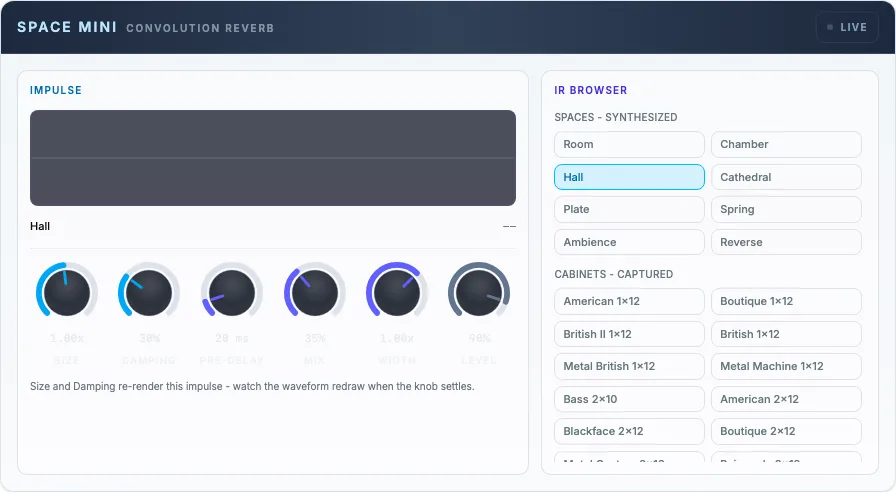
Convolution reverb: eight synthesized spaces, twenty-five real cabinets.