
AvailableEffect
Guitarabin
A fixed pedalboard for spacious guitar.
Announced release
$49 preorder
You are in the live demo. Included formats, release status, and downloads live on the product page.
About
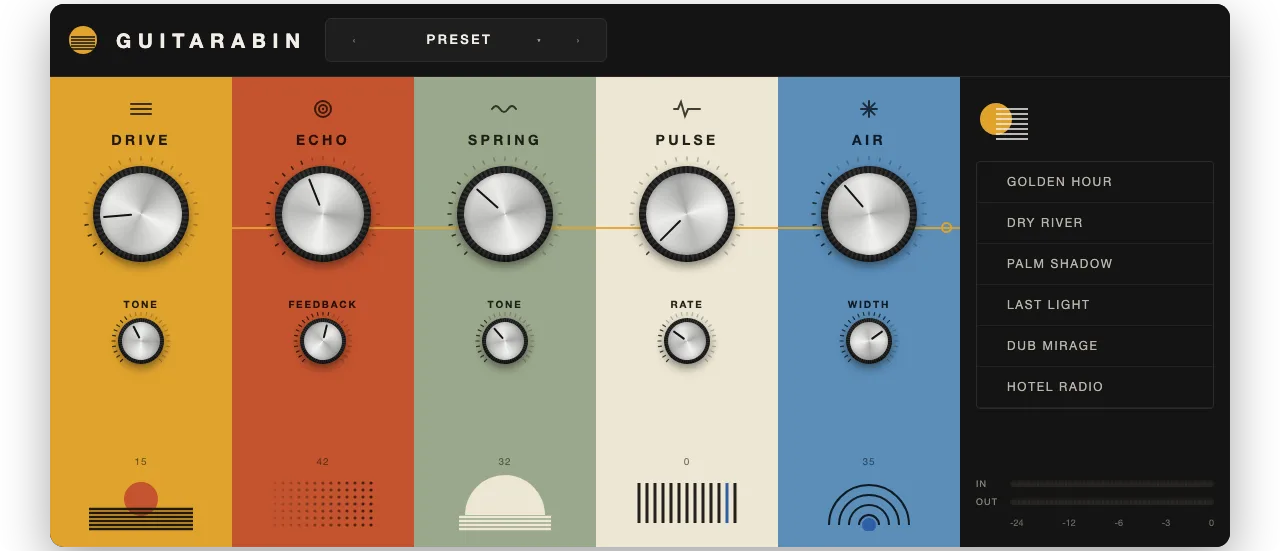
Guitarabin is a pedalboard rather than a rack: the stages are in a fixed order and you cannot repatch them. That is the point. It is modelled on two instrumental guitar rigs that are themselves fixed boards - the wet, dark, reverb-soaked sound of Khruangbin's Mark Speer, and the desert/spaghetti-western tone of Hermanos Gutierrez - and both of those sounds come from a small number of pedals left in one order and played, not from routing flexibility.
The two rigs share more than they differ. Both run an MXR Dyna Comp into an essentially clean amp, both lean on a Strymon El Capistan tape echo, and both play through a Fender Deluxe Reverb. So the chain here is their intersection: a compressor, a low-gain boost that never reaches distortion, a dark tone stage standing in for flatwound strings and a blackface amp, modulation, and then the two time effects that do most of the work.
The detail worth understanding is one you cannot change. A rig rundown of Speer's board puts the reverb BEFORE the delay, backwards from the usual advice, and it matters: with reverb first, every repeat is a copy of an already-reverberant signal, so the echoes get more diffuse as they decay and smear into a wash rather than staying discrete. That order is welded here rather than switchable, because it is the character of the circuit - a control to turn the defining trait off is a control to make the module sound like everything else.
Preview honesty: this page can run either the lightweight Web Audio approximation or the versioned optimized Guitarabin engine. Choose the engine from Audio & MIDI in the top-right menu. Browser/plugin parity claims apply only when the optimized engine is selected; the Web Audio tone and delay behaviour remain a musical approximation of the reference rigs, not measurements of specific pedals.
System requirements.
The downloadable Guitarabin release supports the hosts and systems listed below.
- VST3macOS · arm64
Works in Ableton Live, Reaper, Cubase, Studio One, Bitwig and FL Studio.
Version 0.0.0
Build evidence
Every row below is a recorded build row or the recorded absence of one. Nothing here is inferred from what this module is meant to support.
- Module
- music.codex.guitarabin v0.0.0
- Built at
- Closure hash
- 62d00611d29f…
- Toolchain
- scriptc 64acce1ae3b8…
- moduleToolchainDist c621ffab721d…
- pluginShellKitRuntime bca003784692…
- faceShellGeneration 8533207ab81f…
- uiPreservation cd28dbd7e3d6…
- packagerVersion 3
| Format | Result | Download |
|---|---|---|
| Browser package (JS) | Builtweb bundle sha256 5697107a070b… · 761 KB | Built, but no downloadable archive was recorded. |
| Browser package (WASM) | Builtweb bundle sha256 160cc1bb2f30… · 2.0 MB | Built, but no downloadable archive was recorded. |
| VST3 | Builtdarwin-arm64Steinberg validator + VST3 host render: passed bundle sha256 c604966dc56a… · 2.2 MB | CodexGuitarabin-vst3-darwin-arm64.zip archive sha256 0ebf703735f2… · 2.2 MB · darwin-arm64 |
| Audio Unit | Not built no recorded artifact row for au; native-lane-report.json is absent or records no au row for this module | Not built for macOS |
| CLAP | Not built no recorded artifact row for clap; native-lane-report.json is absent or records no clap row for this module | Not built for macOS, Windows or Linux |
| Standalone app | Not built no recorded artifact row for standalone; native-lane-report.json is absent or records no standalone row for this module | Not built for macOS, Windows or Linux |
Parity
browser-js = browser-wasm = vst3 qualified against their own recorded digests. Not recorded: au, clap, standalone.
Presets
Start from a named sound, then adjust the instrument to make it yours.
InitGolden HourDry RiverPalm ShadowLast LightDub MirageHotel Radio
Popular presets for Guitarabin
Open a sound shared by the community, then play it in this module.
Found in collections
Signal graph.
ExperimentalMigration fallback: approximated from parameter groups, not a runtime wiring diagram.
How it works.
The pre-chain is fixed and conventional: a peaking biquad for the parked wah, a compressor, a waveshaper, then a shelf pair for tone, then the two modulation stages. The drive curve is a tanh capped at about 9x pre-gain, which is low - the stage is there to thicken and boost, and running it as a distortion is not a sound either reference rig makes.
The two modulation stages are genuinely different effects and are wired that way. Tremolo is an LFO summed with a DC offset into a gain, with the offset set to 1 minus half the depth so the effect swings around unity instead of only ducking. Vibrato is an LFO on a delay line's time, which is a real pitch shift; depth is specified in cents and converted through the delay-modulation relation (peak pitch deviation is 2*pi*rate*swing), then clamped under the centre tap so the line can never go negative.
The delay is a single tap with the feedback path damped and saturated before it returns, so repeats both darken and compress as they pile up - the tape behaviour, rather than a clean digital repeat that eventually clips. Tape Age moves the damping corner from 8 kHz down to 1.8 kHz and simultaneously opens a slow LFO on the delay time for wow and flutter, because on a real machine those are the same fact about the same worn transport.
The reverb is a small feedback-delay network - four short diffusion delays in series feeding four damped parallel combs - not a convolver. That is a deliberate split of responsibility with Space Mini, which does own a convolution reverb: an FDN gives a decay knob that actually re-tunes the tail, and comb feedback is derived from the target decay by the standard relation g = 10^(-3t/RT60). The tail is damped harder than the output, so highs die before lows.
The panel exposes ten knobs, not twenty. Several are macros that fan out to more than one engine value, because the pedals they stand in for do too: one Echo knob moves repeat spacing and wet level together, and Feedback carries tape age with it, since more passes over the head is what wear actually is. That expansion lives in one function in the plugin's schema, which both the plugin and this page call, so a knob means the same thing in a DAW as it does here.
Width is a mid/side matrix on the wet path only, fed by a decorrelated copy of the chain output - a mono pedal chain has no side component at all, and no amount of matrixing invents one. Below halfway the tail collapses toward the centre while the dry note keeps its own image untouched.
Part of these racks.
A rack is a fixed rig: several modules already wired together, playable as one instrument. This module is one of the pieces.
- Tetra Box rack
Sloop writes a pattern, Tetra Box plays it on sixteen pads, Guitarabin colours the output.
3 modules · sloop → tetra-box → guitarabin
Goes well with.

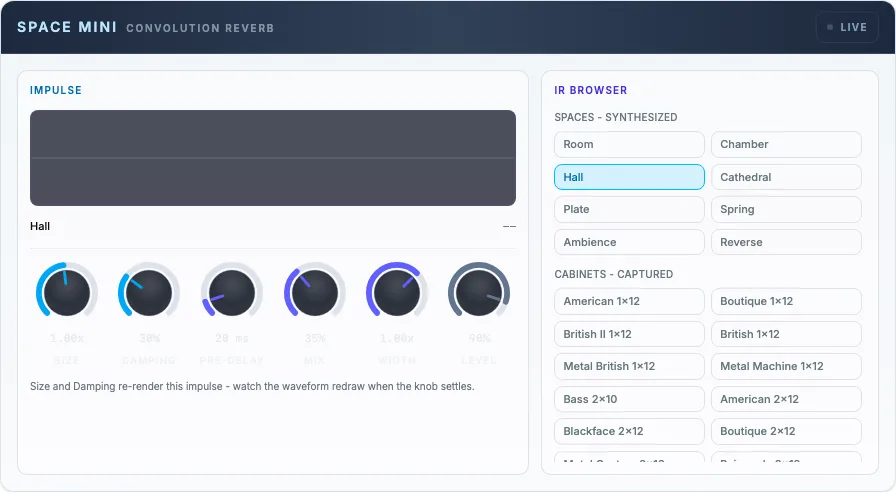
Space Mini
Convolution reverb: eight synthesized spaces, twenty-five real cabinets.
PreviewNo build recorded
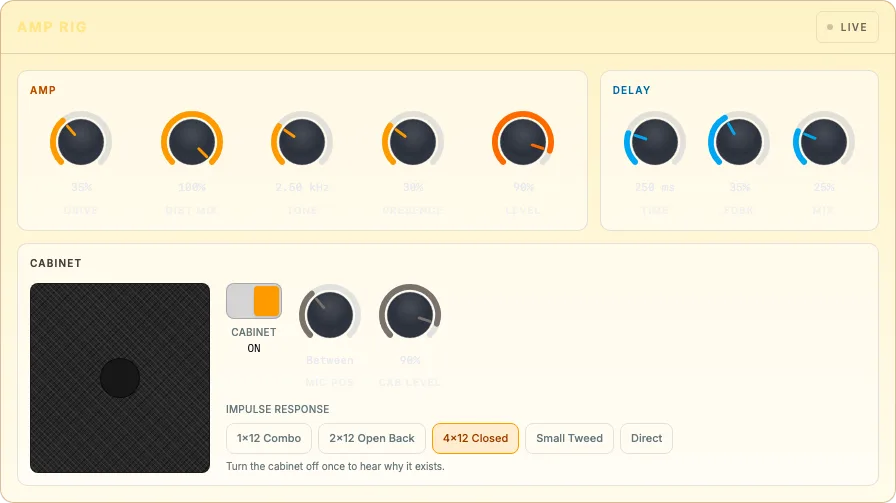
Amp Rig
Tube-style drive into a real cabinet.
PreviewNo build recorded
FX Mini
Drive, tone, and bounded feedback delay.
Preview