EQ
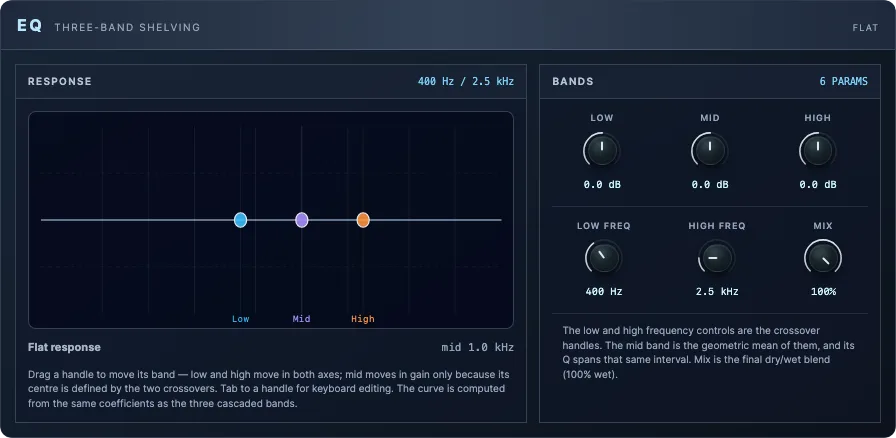
Three-band equalization with two crossovers.
PreviewNot built for macOS, Windows or Linux
Six bands, a curve you can drag, and a bit-exact bypass.
Engine preview
VST3
A six-band stereo parametric EQ with per-band type, frequency, Q and gain, an output trim, and fixed-role defaults in the classic channel-EQ idiom. With every band off and the trim at 0 dB it copies its input byte for byte.
The downloadable Parametric EQ release supports the hosts and systems listed below.
Works in Ableton Live, Reaper, Cubase, Studio One, Bitwig and FL Studio.
Every row below is a recorded build row or the recorded absence of one. Nothing here is inferred from what this module is meant to support.
| Format | Result | Download |
|---|---|---|
| Browser package (JS) | Builtweb bundle sha256 fdf1b9fd60ca… · 311 KB | Built, but no downloadable archive was recorded. |
| Browser package (WASM) | Builtweb bundle sha256 0775e5a524e6… · 2.0 MB | Built, but no downloadable archive was recorded. |
| VST3 | Builtdarwin-arm64Steinberg validator + VST3 host render: passed bundle sha256 d4744101f3f1… · 2.2 MB | CodexParametricEq-vst3-darwin-arm64.zip archive sha256 ae225abfc747… · 2.2 MB · darwin-arm64 |
| Audio Unit | Not built no recorded artifact row for au; native-lane-report.json is absent or records no au row for this module | Not built for macOS |
| CLAP | Not built no recorded artifact row for clap; native-lane-report.json is absent or records no clap row for this module | Not built for macOS, Windows or Linux |
| Standalone app | Not built no recorded artifact row for standalone; native-lane-report.json is absent or records no standalone row for this module | Not built for macOS, Windows or Linux |
Parity
browser-js = browser-wasm = vst3 qualified against their own recorded digests. Not recorded: au, clap, standalone.
Start from a named sound, then adjust the instrument to make it yours.
Migration fallback: approximated from parameter groups, not a runtime wiring diagram.
Six bands, each one a fused biquad that can be a bell, a low or high shelf, a low or high cut, or a notch. The defaults are the Logic-style fixed-role layout - a low cut at 30 Hz, a low shelf at 120 Hz, bells at 500 Hz and 2 kHz, with a high shelf and high cut present but disabled - so the module opens flat and every band is already where you would have put it.
The curve the editor draws is the design the kernel runs. Band handles drag for frequency and gain and take a wheel or modifier for Q, and the cut and notch shapes lock the gain axis automatically because they have no gain of their own.
Bypass is a guarantee rather than a tolerance. With every band disabled and the trim at exactly 0 dB the kernel short-circuits and copies the input, and the module's tests assert that byte for byte instead of measuring it against a threshold.
Stereo is two mono band-set lanes with identical parameters, the same pattern the Gate uses. Because the coefficients are identical and only the delay state differs, phase coherence between the channels is exact - which is why the node deliberately does not claim to be stereo-capable, a flag that means two decorrelated paths.
Three-band equalization with two crossovers.
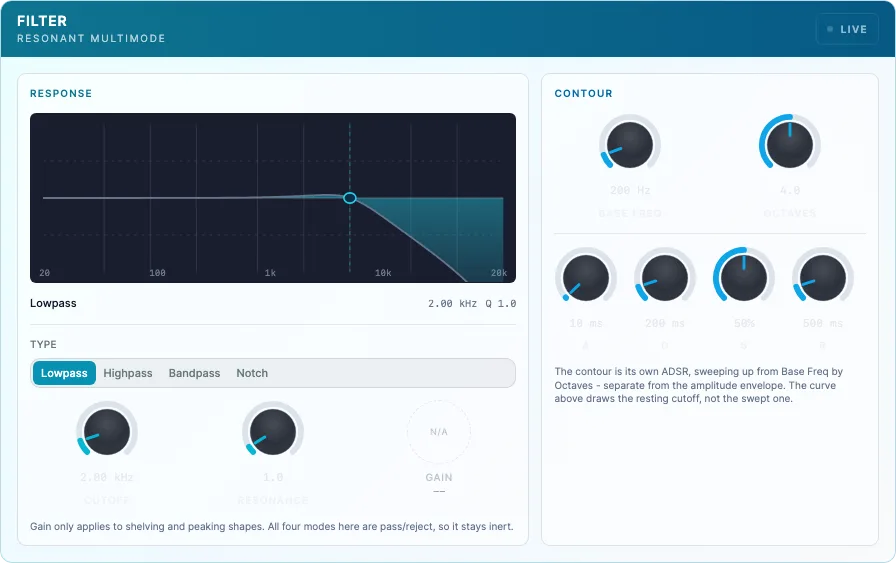
A resonant low-pass filter for shaping tone.
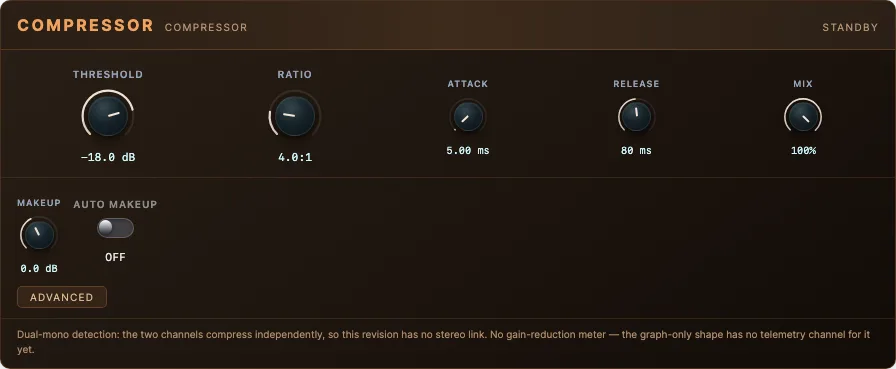
A full dynamics compressor with a filterable detector.
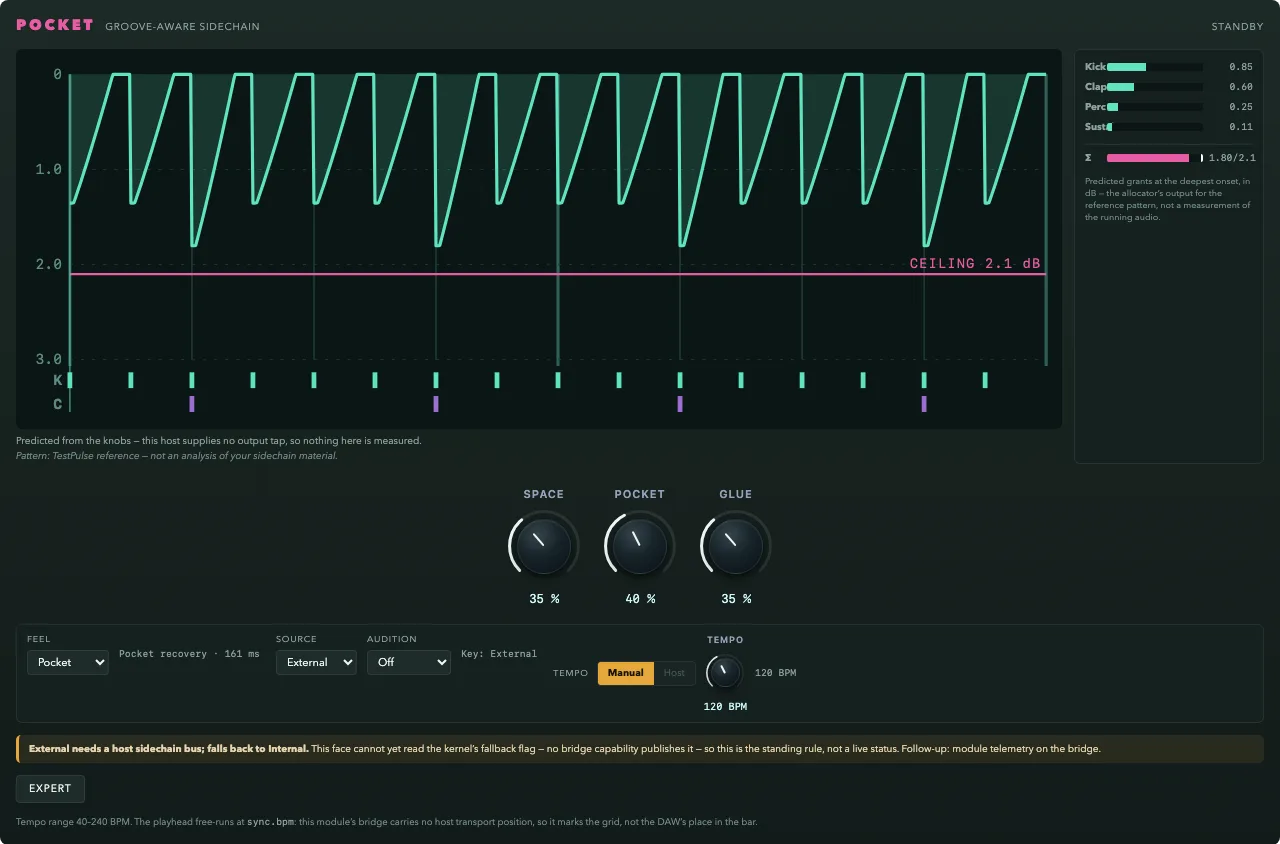
Sidechain that gives the room back in the groove.