Filter
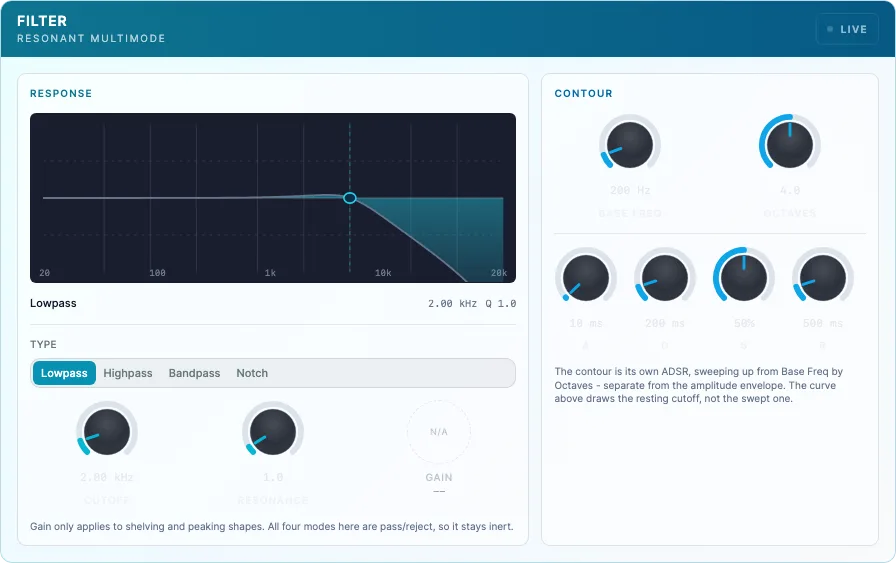
A resonant low-pass filter for shaping tone.
PreviewNot built for macOS, Windows or Linux
Three-band equalization with two crossovers.
Engine preview
Not built for macOS, Windows or Linux
A three-band shelving EQ with movable crossover points. Low and high are shelves, mid is whatever is left between them - the classic mixer tone stack, drawn as the curve it actually produces.
Every row below is a recorded build row or the recorded absence of one. Nothing here is inferred from what this module is meant to support.
| Format | Result | Download |
|---|---|---|
| Browser package (JS) | Not built by this module's lane this module has no release.json; its packager lane records no browser program rows | Not built for the browser |
| Browser package (WASM) | Not built by this module's lane this module has no release.json; its packager lane records no browser program rows | Not built for the browser |
| VST3 | Not built no recorded artifact row for vst3; native-lane-report.json is absent or records no vst3 row for this module | Not built for macOS, Windows or Linux |
| Audio Unit | Not built no recorded artifact row for au; native-lane-report.json is absent or records no au row for this module | Not built for macOS |
| CLAP | Not built no recorded artifact row for clap; native-lane-report.json is absent or records no clap row for this module | Not built for macOS, Windows or Linux |
| Standalone app | Not built no recorded artifact row for standalone; native-lane-report.json is absent or records no standalone row for this module | Not built for macOS, Windows or Linux |
Parity
No lane recorded an artifact; there is no parity evidence.
Start from a named sound, then adjust the instrument to make it yours.
The exact normalized graph packaged for the shared browser/native runtime and exports.
Three cascaded biquads: a low shelf at the low crossover, a high shelf at the high crossover, and a peaking band centred between them. Their responses multiply, which is why the displayed curve is the product of the three and not three separate humps.
The curve on the panel is computed rather than measured. Each band's coefficients come from the RBJ cookbook formulas and are evaluated directly as the magnitude response, so the drawing matches what the filters will do without needing an analyser running.
In the browser preview the three bands run as cascaded Web Audio biquads carrying the same coefficients the curve is drawn from, so the picture and the sound are the same filter. That preview is a stand-in for the compiled kernel rather than the kernel itself - the paths are the kernel's, so the real filter drops in without a rename.