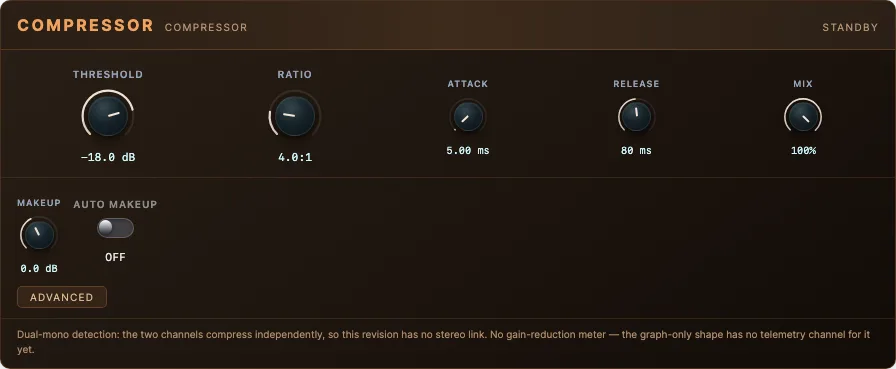
Compressor
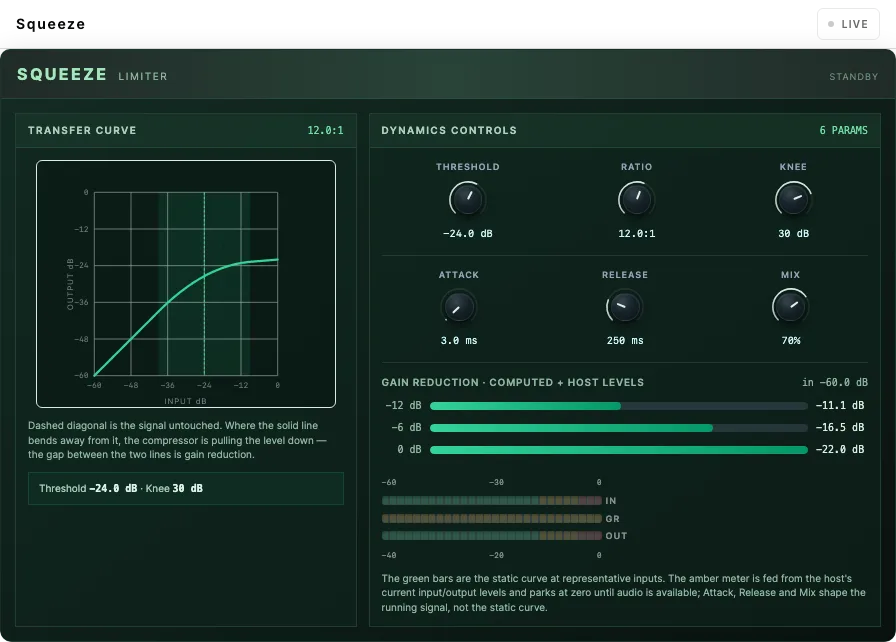
A full dynamics compressor with a filterable detector.
PreviewNot built for macOS, Windows or Linux
Sidechain that gives the room back in the groove.
Announced release
$29 preorder
You are in the live demo. Included formats, release status, and downloads live on the product page.
Pocket is not a generic unmasker. It does not analyse two spectra and subtract one from the other, and it does not try to fix a mix. It is a rhythmic priority processor: it assumes the drums matter, it detects when they hit, and it schedules the recovery musically. The reduction budget exists so that the answer to 'more' is never 'hollow'.
The depths it makes easy are much smaller than the category's reputation suggests, and this is deliberate. The sources are unusually consistent that the classic technique rarely pushes past two or three dB per hit, and that around six dB is where obvious pumping starts. So the Space macro's taper is weighted to spend the first half of its travel on the first three dB, and the factory presets sit between two and five. A version tuned to be dramatic would misrepresent what the control is for.
Three macros carry the product - Space for how much room, Pocket for the timing feel, Glue for how the reduction is delivered and how much bus compression and saturation come up. Everything underneath is on an expert page generated from the module's own panel definitions, so precision is available without every control being in the way first.
What is not proved yet, stated plainly: the built plugin declares a sidechain bus and the Steinberg validator passes it, but no host has been shown delivering audio on that bus, so the external-sidechain audio path is unsupported in the plugin lanes rather than quietly assumed. Live gain-reduction telemetry is absent for the same reason the Compressor has no meter - nothing on the bridge publishes it, and a drawn zero would be a fabrication.
The downloadable Pocket release supports the hosts and systems listed below.
Works in Ableton Live, Reaper, Cubase, Studio One, Bitwig and FL Studio.
Every row below is a recorded build row or the recorded absence of one. Nothing here is inferred from what this module is meant to support.
| Format | Result | Download |
|---|---|---|
| Browser package (JS) | Builtweb bundle sha256 d5752102f201… · 612 KB | Built, but no downloadable archive was recorded. |
| Browser package (WASM) | Builtweb bundle sha256 98c1278b960d… · 2.1 MB | Built, but no downloadable archive was recorded. |
| VST3 | Builtdarwin-arm64Steinberg validator + VST3 host render: passed bundle sha256 527c0f737239… · 2.2 MB | CodexPocket-vst3-darwin-arm64.zip archive sha256 66a557b6e85a… · 2.2 MB · darwin-arm64 |
| Audio Unit | Not built no recorded artifact row for au; native-lane-report.json is absent or records no au row for this module | Not built for macOS |
| CLAP | Not built no recorded artifact row for clap; native-lane-report.json is absent or records no clap row for this module | Not built for macOS, Windows or Linux |
| Standalone app | Not built no recorded artifact row for standalone; native-lane-report.json is absent or records no standalone row for this module | Not built for macOS, Windows or Linux |
Parity
browser-js = browser-wasm = vst3 qualified against their own recorded digests. Not recorded: au, clap, standalone.
Start from a named sound, then adjust the instrument to make it yours.
Migration fallback: approximated from parameter groups, not a runtime wiring diagram.
Four detector lanes listen to the sidechain in their own bands - kick, clap and snare, high percussion, and sustained energy - and each one asks for a share of the reduction. The lanes are level-independent by design, so the depth you get does not change when the drum bus gets louder.
Those requests are not simply added together. A weighted soft-knee allocator grants them against a single budget set by the Space macro, so simultaneous hits cannot accumulate into a hole. The budget is never exceeded, and the face draws its ceiling as a hard line because that is a product claim rather than an implementation detail.
Recovery is the part that makes it musical. Instead of a fixed millisecond release, the duck recovers over a note division shaped by feel - Tight snaps, Laid Back hangs, Open moves continuously - with MPC swing displacing alternate recoveries and an adaptation term that follows the detected spacing between kicks when the passage changes tempo feel.
The low end is handled separately. An LR2 crossover splits off a mono band below the crossover point and the broadband duck is applied there, which is what keeps a bass full and centred between kicks; above it, when Glue is high, the reduction is delivered through block-rate bells instead, so a pad's density survives what would otherwise be a hole.
The Groove Scope is a prediction, not a measurement, and it says so. It is computed from the same parameters the audio runs on, so it is correct the instant the page paints - and where no host supplies an output tap the caption states plainly that nothing on screen is measured, rather than drawing a convincing trace.
A full dynamics compressor with a filterable detector.
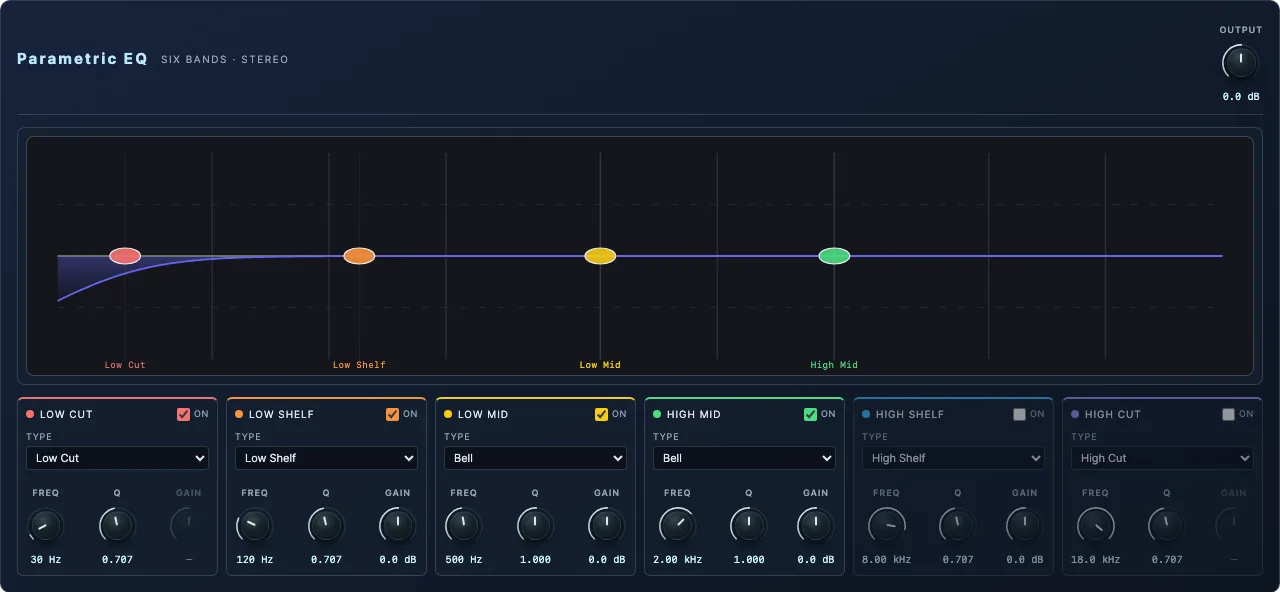
Six bands, a curve you can drag, and a bit-exact bypass.
A compressor with visible gain reduction.
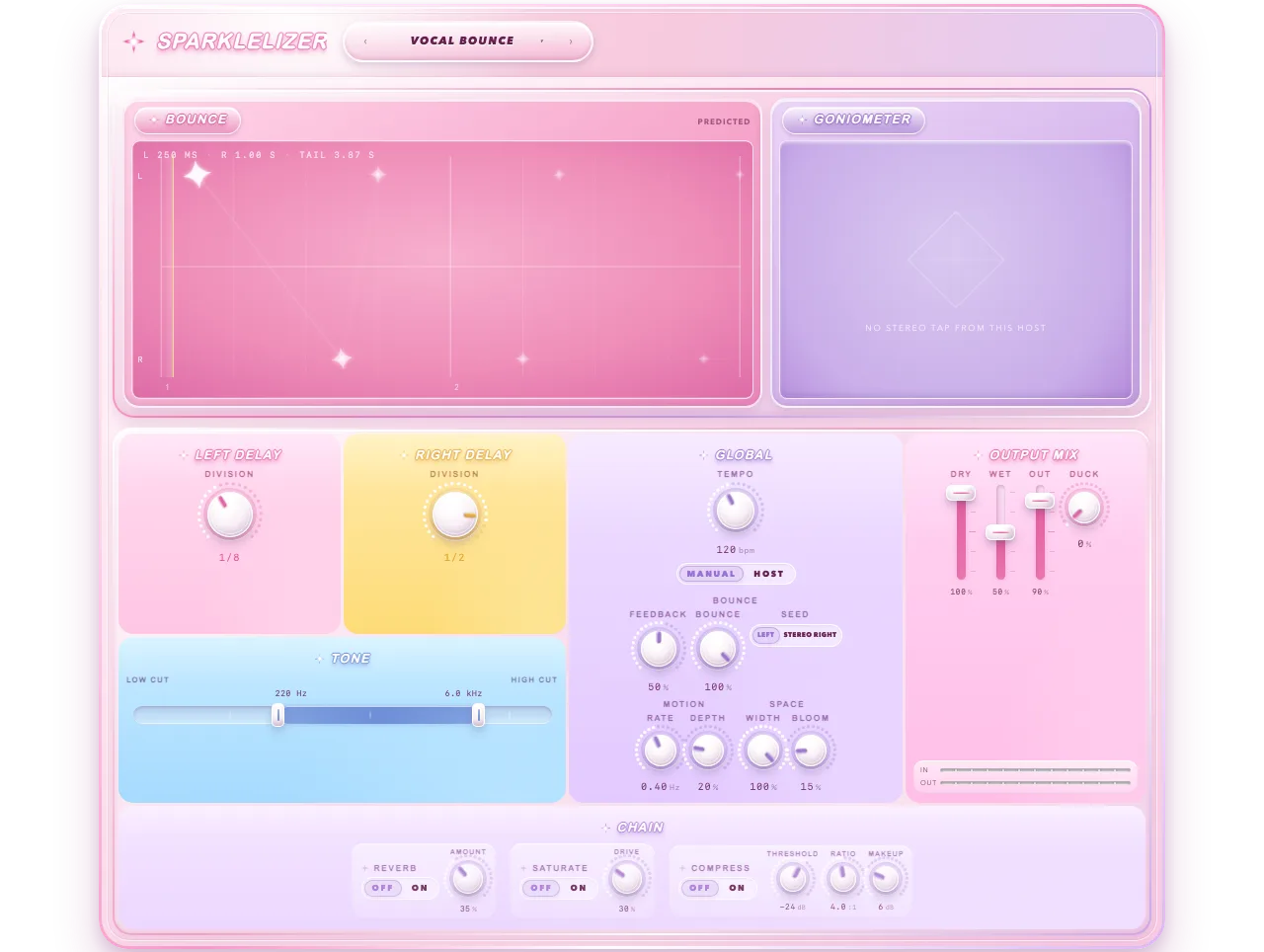
A stereo delay that shows each repeat as it moves across the beat.