Sparklelizer product page
AvailableEffect

Sparklelizer

A stereo delay that bounces, with the bounce drawn.

Announced release

$39 preorder

View product details

You are in the live demo. Included formats, release status, and downloads live on the product page.

About

Jazz builds the sound from around sixteen layers of the same vocal: the lead dead centre, with doubles panned dead left and dead right. On the side layers she puts a tempo-synced stereo delay whose two sides run different note divisions - say an eighth on the left and a half note on the right - and feeds them back into each other. A repeat born on the left re-emerges on the right a half note later, then returns to the left an eighth after that. The doubles bounce across the field while the lead stays put.

The chain is fixed, because the setup being modelled is fixed. Input seeds the two lines, each line is filtered before it plays so every pass thins and darkens, an LFO moves the read position so old repeats swirl more than new ones, then the wet path gets width, a little bloom and an optional duck from the dry input before it meets the untouched lead. There is no repatching, because there is nothing here that was ever patched.

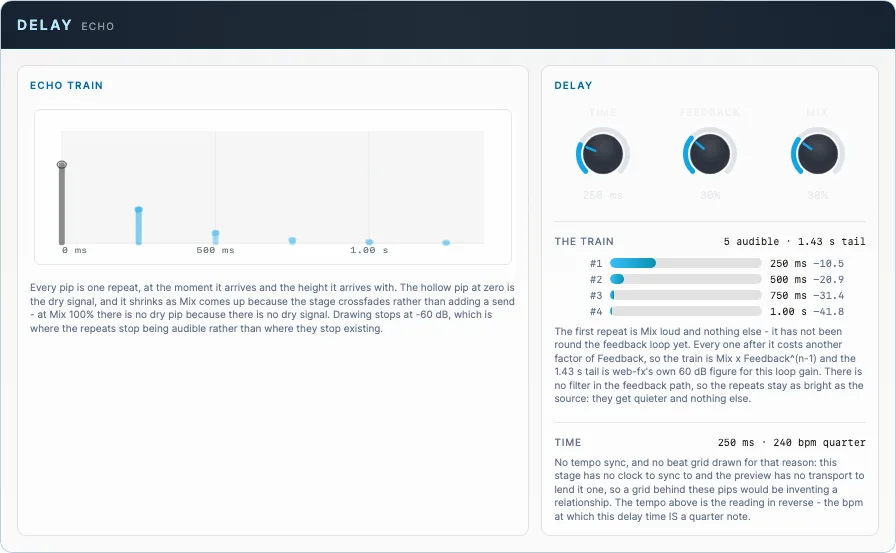
The scope is the product as much as the audio is. It is parameter-side: the repeat train is computed from the same expansion the audio runs on, not measured from an analyser, so it is correct the instant the page paints and it shows you where the repeats will land before you have played a note. Time runs along a beat grid, height is stereo position after Width, brightness and size carry level, and a faint arc links each repeat to the one it came from so the bounce is drawn as a path.

The delay is not the end of the chain, because it was never the end of the chain being modelled. After dry and wet are summed there is a reverb, then a saturator, then a compressor. Reverb and saturation are a switch and one amount each; the compressor is a switch with Threshold, Ratio and Makeup, so you can set where it starts working, how hard it holds what crosses that point, and how much level goes back on afterwards. The reverb is a real room rather than the short bloom that sits on the wet path, the saturator gives the repeats an edge, and the compressor is last on purpose: its makeup gain brings the delay feedback up in volume, which is how the repeats stay audible under the lead instead of falling away between phrases. All three are off by default, and Off skips the stage rather than running it at unity, so a patch that does not use them renders exactly as it did before they existed.

That is the part a stock stereo delay does not do. A stock stereo delay gives you a time and a level per side. This one cross-feeds two different divisions so the repeats travel rather than alternate, mixes them with a real Dry/Wet pair and a duck from the dry vocal instead of a per-side output level, filters inside the feedback loop rather than after it, draws the repeat train on the beat grid before you play a note, and carries the reverb, saturation and compression that would otherwise be three more plugins behind it.

The page can run the same compiled ScriptC kernel as the native formats through a persistent AudioWorklet. Its real-Chromium promotion gate compares the browser render with the restricted-TypeScript oracle, including all 25 controls and the Reverb → Saturation → Compressor chain. The Web Audio implementation remains available as a reference preview, but it is not used as evidence for browser/plugin parity.

Tempo can follow the host on both surfaces. Select Host and each changed website transport or DAW tempo is written through the ordinary `sync.bpm` parameter path; both delay times, the scope and saved parameter state therefore see the same value. Manual leaves the Tempo knob in charge, and unchanged host values are suppressed rather than generating automation traffic every block.


Jazz Calls Home, the artist who partnered on Sparklelizer

Created in partnership

Jazz Calls Home

Experimental pop artist and sound sculptor

Sparklelizer recreates an effect stack Jazz often uses in her compositions. She wanted to share a technique she loves for the sense of space it creates, especially around vocals.

Visit Jazz Calls Home (opens in a new tab)

System requirements.

The downloadable Sparklelizer release supports the hosts and systems listed below.

  • VST3macOS · arm64

    Works in Ableton Live, Reaper, Cubase, Studio One, Bitwig and FL Studio.

Version 0.0.0

Build evidence

Every row below is a recorded build row or the recorded absence of one. Nothing here is inferred from what this module is meant to support.

Module
music.codex.sparklelizer v0.0.0
Built at
Closure hash
46016feaeabd…
Toolchain
  • scriptc 64acce1ae3b8…
  • moduleToolchainDist c621ffab721d…
  • pluginShellKitRuntime bca003784692…
  • faceShellGeneration 8533207ab81f…
  • uiPreservation cd28dbd7e3d6…
  • packagerVersion 3
Build result and download for each format
FormatResultDownload
Browser package (JS)
Builtweb

bundle sha256 a7f17b5a77a2… · 753 KB

Built, but no downloadable archive was recorded.
Browser package (WASM)
Builtweb

bundle sha256 78d8f3a4e6f2… · 2.0 MB

Built, but no downloadable archive was recorded.
VST3
Builtdarwin-arm64Steinberg validator + VST3 host render: passed

bundle sha256 a6840b52fb31… · 2.2 MB

CodexSparklelizer-vst3-darwin-arm64.zip

archive sha256 6afc0aa82358… · 2.2 MB · darwin-arm64

Audio UnitNot built

no recorded artifact row for au; native-lane-report.json is absent or records no au row for this module

Not built for macOS
CLAPNot built

no recorded artifact row for clap; native-lane-report.json is absent or records no clap row for this module

Not built for macOS, Windows or Linux
Standalone appNot built

no recorded artifact row for standalone; native-lane-report.json is absent or records no standalone row for this module

Not built for macOS, Windows or Linux

Parity

browser-js = browser-wasm = vst3 qualified against their own recorded digests. Not recorded: au, clap, standalone.

Presets

Start from a named sound, then adjust the instrument to make it yours.

InitVocal BounceDotted PongThree Over FourNear And FarSwirl WashDucked SlapFull Chain

Signal graph.

Experimental

Migration fallback: approximated from parameter groups, not a runtime wiring diagram.

How it works.

Both lines are cut from one grid. `sync.left` and `sync.right` are indices into a division table shortest-first, times are the beat times the division, and anything longer than the four-second line folds down an octave at a time rather than clamping - a whole bar at 40 BPM becomes a half bar, still musical, and the scope badges that it happened instead of hiding it.

Feedback and Bounce are two different questions about one number. Feedback is the gain per pass, capped at 0.95 because with the loop filter in the path this module rains rather than self-oscillates. Bounce splits that gain between re-entering the same line and crossing to the other one, and the split is level-preserving, so moving it changes where the tail travels without changing how long it lasts.

Tone is inside the loop, not after it. A second-order high-pass and low-pass sit before each line, so every pass thins and darkens a little more and the repeats recede behind the lead instead of accumulating under it. The 220 Hz default low cut is the interview's own setting, chosen so repeats never mud the mix.

Motion is a sine LFO on each line's read position, the two sides in quadrature, mapping depth onto up to six milliseconds of swing. Because it modulates inside the loop, a repeat swirls further the longer it has been alive - which is the phaser-like behaviour the producer described, rather than a static chorus on the output.

Width and bloom touch the wet path only, so the dry lead's image is never smeared, and Duck is a sidechain from the dry input onto the wet level - up to 18 dB down with a 220 ms release, so repeats step aside while the vocal is singing and come back up in the gaps. Quadrature phase, bloom-after-width order, the duck timing and the feedback ceiling are fixed by design and are not knobs.

The chain stages sit after the dry and wet paths are summed and before the output trim, in one fixed order: reverb, then saturation, then compression. Reverb and saturation are a toggle and a single amount; compression is a toggle with Threshold, Ratio and Makeup, and it runs last because its makeup gain brings the delay feedback up in volume rather than pushing the lead down. Off skips a stage entirely rather than running it at unity, so with all three off the render is sample-for-sample the one the module produced before the chain existed.

Every derivation - seconds, hertz, linear gains, the feedback split - lives in one `expandParams` function in the plugin's schema, which this page, the panel's scope and the compiled kernel all agree on, so a knob means the same thing in a DAW as it does here and as the scope draws it.

Goes well with.

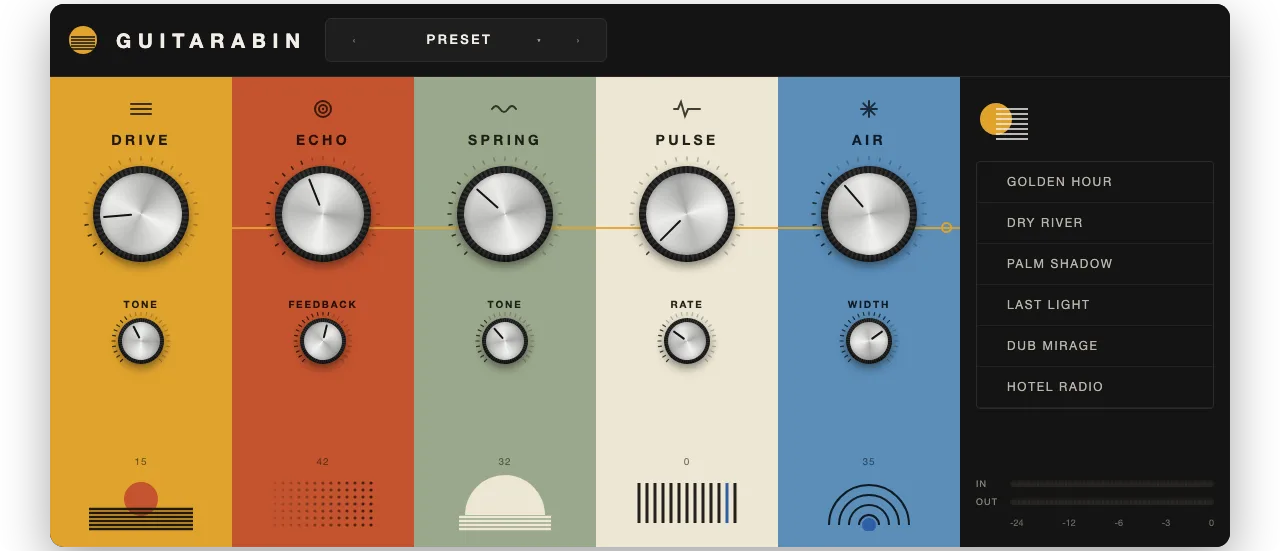
Guitarabin

A fixed pedalboard for spacious guitar.

$49 preorder
Preview

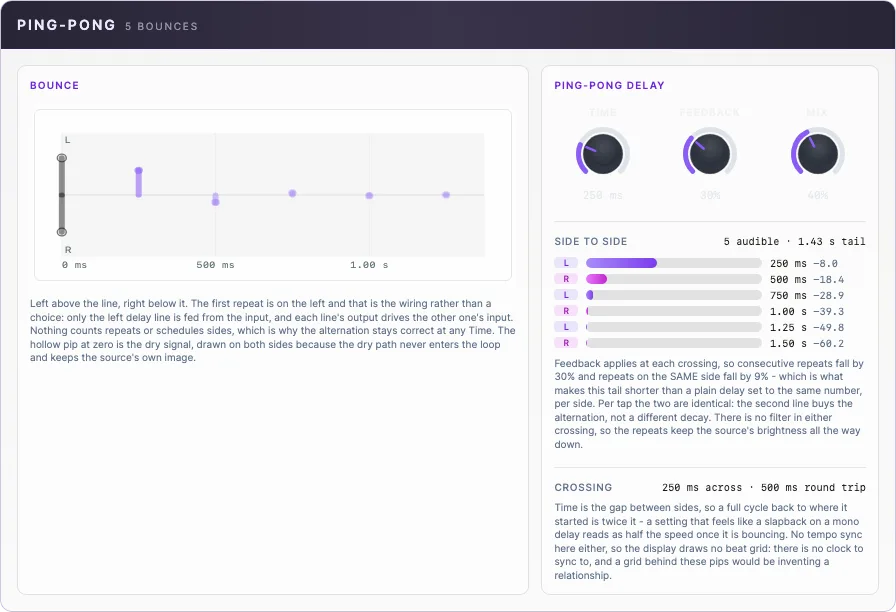
Ping-Pong Delay

Cross-coupled delay with alternating repeats.

PreviewNot built for macOS, Windows or Linux
Preview

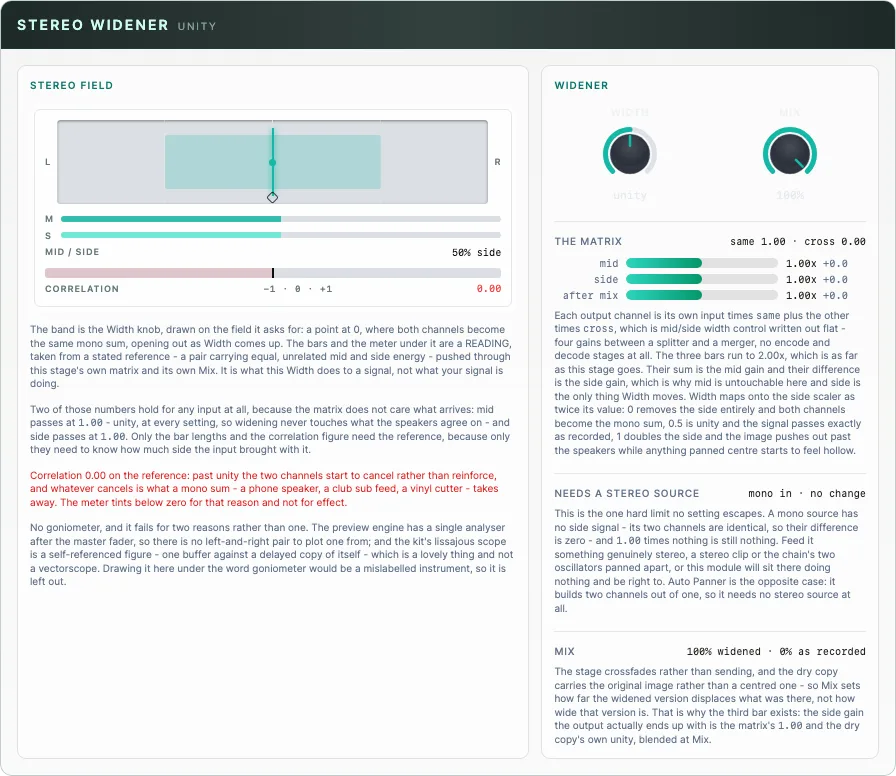
Stereo Widener

Adjust stereo width without changing the dry signal.

PreviewNot built for macOS, Windows or Linux
Preview

Delay

A bounded feedback delay for repeats and ambience.

PreviewNot built for macOS, Windows or Linux