Amp Rig
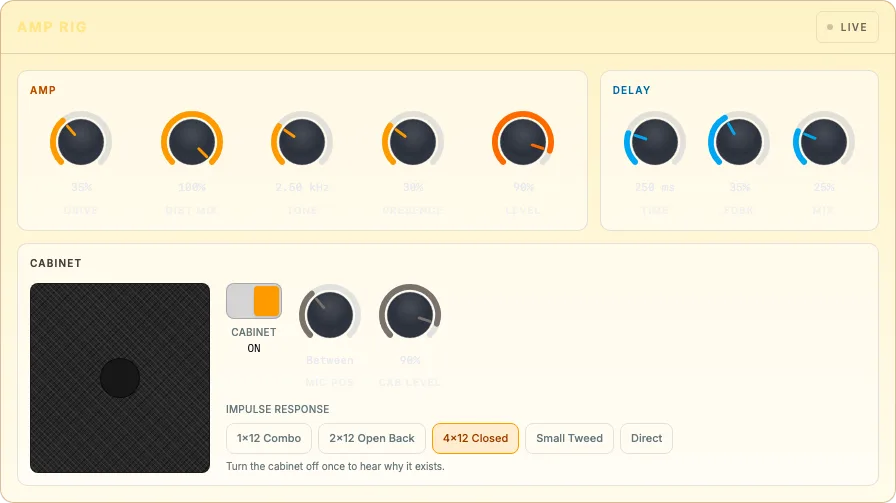
Tube-style drive into a real cabinet.
PreviewNo build recorded
A channel vocoder for any live or recorded input.
Engine preview
Browser version
This is an audio effect, not a keyboard instrument. The module player's existing source strip sends a hosted take, local file, or microphone into the effect, exactly as it does for Amp Rig. In Voice input mode that signal drives the analysis bank while a built-in saw supplies the carrier.
A channel vocoder splits two signals into matching frequency bands. The modulator side is rectified and smoothed into one envelope per band; those envelopes open and close the matching bands of the carrier. The result keeps the carrier's texture while borrowing the modulator's changing spectral shape.
The browser preview is a native Web Audio graph for immediate auditioning. It uses a symmetric one-pole follower approximation because Web Audio has no asymmetric envelope-follower node. The kit's portable engine is authoritative: it applies independent attack and release coefficients per sample and is the path used for parity and export validation.
The compiled kernel keeps its true two-input external-sidechain mode. The single-input website demo adapts that mode into Voice input: the selected audio becomes the modulator and a built-in synth becomes the carrier. Self and noise modes retain the input-as-carrier effect workflow.
Start from a named sound, then adjust the instrument to make it yours.
Migration fallback: approximated from parameter groups, not a runtime wiring diagram.
The normal module source strip feeds the analysis input in Voice mode, and a pair of built-in saw oscillators feeds the carrier bank. In Self mode the selected audio feeds both banks. In noise modes the selected audio is the carrier and deterministic noise feeds the analysis bank.
Both banks use logarithmically spaced band-pass filters. Every analysis band is rectified and smoothed, then connected to the gain of the carrier band at the same index. Moving the two frequency ranges apart remaps spectral activity rather than merely changing tone.
The panel is a controlled adapter over the exact module parameter paths, and the mapping display comes from the same band-frequency model used by the kernel adapter. There is no second copy of audio state and no microphone handling inside the panel.
Tube-style drive into a real cabinet.
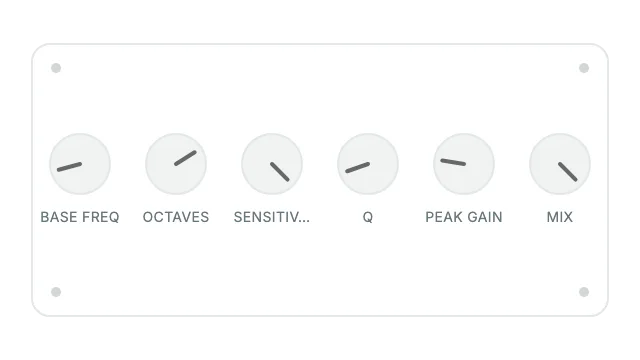
A resonant filter driven by your playing level.
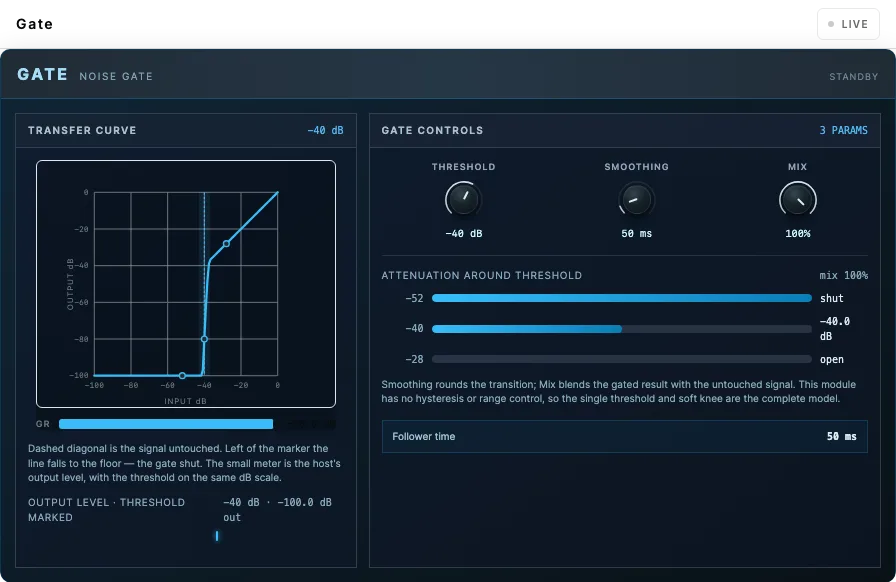
A noise gate with a clear threshold.
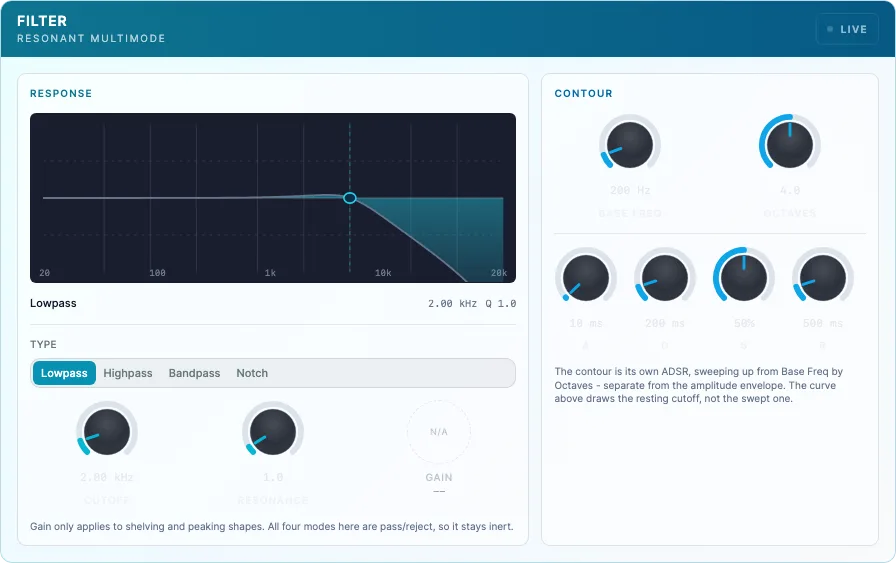
A resonant low-pass filter for shaping tone.